Join Our JEE Preparation Group
Prep with like-minded aspirants; Get access to free daily tests and study material.
Sign in
Please select an account to continue using cracku.in
↓ →
Join Our JEE Preparation Group
Prep with like-minded aspirants; Get access to free daily tests and study material.
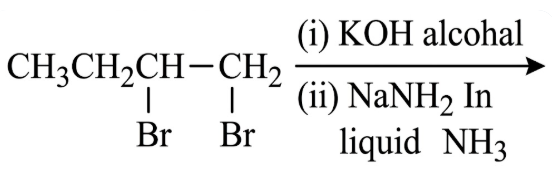
We first look carefully at the given substrate. $$CH_3CH_2CH(Br)CH_2Br$$ Numbering the carbon chain from the left it is $$C_1 = CH_3,\;C_2 = CH_2,\;C_3 = CH(Br),\;C_4 = CH_2Br$$ - that is, a vicinal (adjacent) 1,2-dibromide.
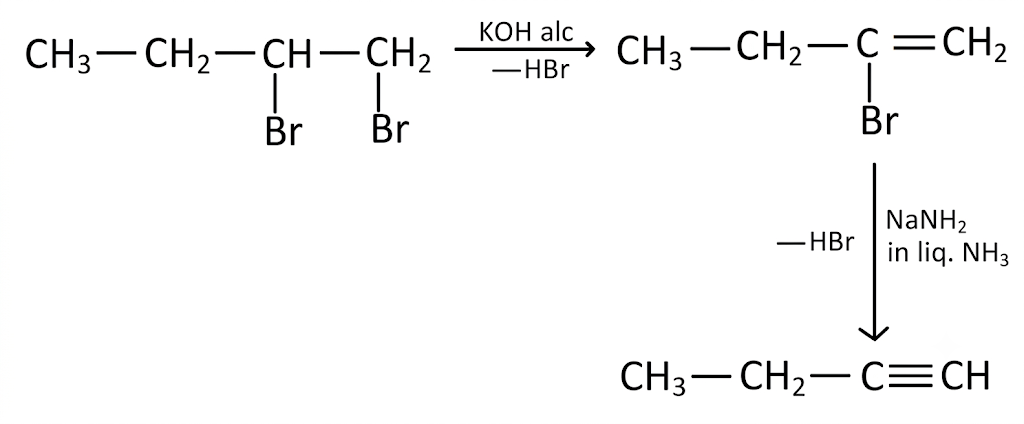
Step (i) : treatment with alcoholic $$KOH$$ - E2 dehydro-halogenation. The E2 rule tells us that one bromine atom and a β-hydrogen situated anti-periplanar to it are lost simultaneously as $$KBr$$ and $$H_2O$$ to give an alkene. On $$C_3$$ there is the leaving group $$Br$$; the β-hydrogens that can be removed are found on $$C_4$$. Removing the hydrogen from $$C_4$$ together with the bromine on $$C_3$$ produces the following alkene:
$$\displaystyle CH_3CH_2C(Br)=CH_2 $$
This product is called 3-bromobut-1-ene (or 1-bromo-1-butene). Note that only ONE molecule of $$HBr$$ has been removed, so the molecule still contains one bromine atom, now attached directly to the vinylic carbon $$C_3$$.
Step (ii) : treatment with $$NaNH_2$$ in liquid $$NH_3$$ - very strong base. A vinylic bromide such as $$CH_3CH_2C(Br)=CH_2$$ undergoes another elimination of $$HBr$$ when it is exposed to a base as strong as sodamide. The general rule (which should be stated) is: “A geminal or vinylic halide, when treated with excess $$NaNH_2$$ in liquid $$NH_3$$, loses a second molecule of $$HBr$$ to give an alkyne.”
Applying the rule, the base abstracts the sole vinylic hydrogen on $$C_4$$, the bromide ion departs from $$C_3$$, and a second π-bond is introduced between $$C_3$$ and $$C_4$$. Because there is already one π-bond there, a second π-bond converts it into a triple bond:
$$ \begin{aligned} CH_3CH_2C(Br)=CH_2 &\xrightarrow{NaNH_2/NH_3} CH_3CH_2C\!\equiv\!CH \;+\; NH_3Br^- \;+\; NH_2^-H^+\\ &\qquad\qquad(\text{1-butyne}) \end{aligned} $$
Thus after the two successive eliminations (one normal E2 and one very strong-base vinylic E2) the vicinal dibromide is transformed into the terminal alkyne $$CH_3CH_2C\!\equiv\!CH$$, i.e. 1-butyne.
Among the options supplied, this structure corresponds to Option C.
Hence, the correct answer is Option C.
Was this solution helpful?
Click on the Email ☝️ to Watch the Video Solution
Create a FREE account and get:
_1.webp)

Educational materials for JEE preparation

Ask our AI anything

AI can make mistakes. Please verify important information.
AI can make mistakes. Please verify important information.