
Join Our JEE Preparation Group
Prep with like-minded aspirants; Get access to free daily tests and study material.
Sign in
Please select an account to continue using cracku.in
↓ →
Join Our JEE Preparation Group
Prep with like-minded aspirants; Get access to free daily tests and study material.
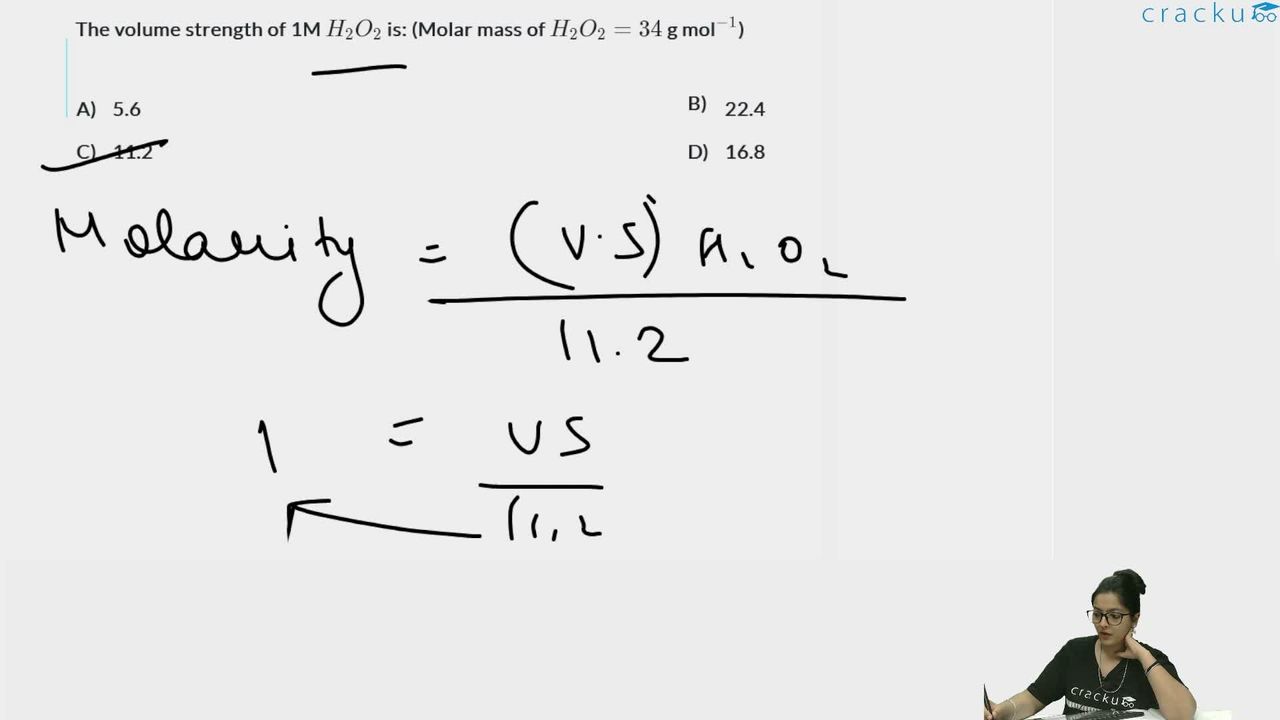
The volume strength of 1M $$H_2O_2$$ is: (Molar mass of $$H_2O_2 = 34$$ g mol$$^{-1}$$)
The phrase “volume strength” of a hydrogen-peroxide solution tells us how many litres of dioxygen at STP are released by one litre of the solution when $$H_2O_2$$ decomposes. The decomposition reaction is first written:
$$2\,H_2O_2 \;\longrightarrow\; 2\,H_2O \;+\; O_2$$
From the balanced equation we see that $$2$$ moles of $$H_2O_2$$ give $$1$$ mole of $$O_2$$. So, for every mole of hydrogen peroxide the moles of oxygen obtained are
$$\text{Moles of }O_2 \;=\;\dfrac{1}{2}\times(\text{moles of }H_2O_2).$$
We are given a $$1\text{ M}$$ solution, which by definition contains $$1$$ mole of solute in $$1$$ litre of solution. Therefore, in $$1$$ litre of this solution the moles of $$H_2O_2$$ present are
$$n_{H_2O_2}=1\;\text{mol}.$$
Using the mole ratio derived above, the moles of dioxygen liberated from this one litre are
$$n_{O_2}= \dfrac{1}{2}\times 1 = 0.5\;\text{mol}.$$
At STP, one mole of any ideal gas occupies $$22.4\;\text{L}$$. Thus the volume of $$O_2$$ produced is calculated with
$$V_{O_2}=n_{O_2}\times 22.4\;\text{L mol}^{-1} = 0.5 \times 22.4 = 11.2\;\text{L}.$$
Because this volume corresponds to one litre of the hydrogen-peroxide solution, the “volume strength” is simply the number of litres of oxygen per litre of solution, namely $$11.2$$. Hence, the solution is termed an “$$11.2$$-volume” hydrogen peroxide.
So, the answer is $$11.2$$.
Was this solution helpful?
Click on the Email ☝️ to Watch the Video Solution
Create a FREE account and get:
_1.webp)

Educational materials for JEE preparation

Ask our AI anything

AI can make mistakes. Please verify important information.
AI can make mistakes. Please verify important information.


