
Join Our JEE Preparation Group
Prep with like-minded aspirants; Get access to free daily tests and study material.
Sign in
Please select an account to continue using cracku.in
↓ →
Join Our JEE Preparation Group
Prep with like-minded aspirants; Get access to free daily tests and study material.
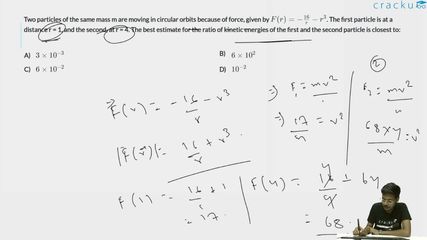
Two particles of the same mass m are moving in circular orbits because of force, given by $$F(r) = -\frac{16}{r} - r^3$$. The first particle is at a distance r = 1, and the second, at r = 4. The best estimate for the ratio of kinetic energies of the first and the second particle is closest to:
We are told that both particles are of the same mass $$m$$ and are moving in circular orbits under a central force
$$F(r)= -\frac{16}{r}-r^{3}.$$
The negative sign merely shows that the force is attractive, so for the purpose of balancing the centripetal requirement we will use its magnitude
$$|F(r)|=\frac{16}{r}+r^{3}.$$
For a body of mass $$m$$ in uniform circular motion of radius $$r$$ and speed $$v$$, the centripetal force is given by the standard relation
$$F_{\text{centripetal}}=\frac{m v^{2}}{r}.$$
Because the circular motion is maintained by the given force, we equate the magnitudes:
$$\frac{m v^{2}}{r}= \frac{16}{r}+r^{3}.$$
Multiplying both sides by $$r$$ to clear the denominator, we get
$$m v^{2}= 16 + r^{4}.$$
Now we solve for $$v^{2}$$:
$$v^{2}= \frac{16 + r^{4}}{m}.$$
The kinetic energy of a particle is expressed by the familiar formula
$$K=\frac{1}{2} m v^{2}.$$
Substituting the value of $$v^{2}$$ obtained above, we obtain
$$K=\frac{1}{2} m\left(\frac{16 + r^{4}}{m}\right)=\frac{1}{2}(16 + r^{4}).$$
Notice that the mass $$m$$ cancels out, so the kinetic energy depends only on the radius:
$$K(r)=8 + \frac{r^{4}}{2}.$$
For the first particle, the radius is $$r_{1}=1$$. Substituting $$r=1$$ in the expression for $$K(r)$$, we have
$$K_{1}=8 + \frac{1^{4}}{2}=8 + \frac{1}{2}=8.5.$$
For the second particle, the radius is $$r_{2}=4$$. Substituting $$r=4$$, we get
$$K_{2}=8 + \frac{4^{4}}{2}=8 + \frac{256}{2}=8 + 128=136.$$
We need the ratio of the kinetic energies of the first particle to the second particle:
$$\frac{K_{1}}{K_{2}}=\frac{8.5}{136}.$$
Dividing numerator and denominator by 136, or using a calculator, gives
$$\frac{K_{1}}{K_{2}}\approx 0.0625=6.25 \times 10^{-2}.$$
Among the options provided, $$6 \times 10^{-2}$$ is closest to this numerical value.
Hence, the correct answer is Option C.
Was this solution helpful?
Click on the Email ☝️ to Watch the Video Solution
Create a FREE account and get:
_1.webp)

Educational materials for JEE preparation

Ask our AI anything

AI can make mistakes. Please verify important information.
AI can make mistakes. Please verify important information.
