
Join Our JEE Preparation Group
Prep with like-minded aspirants; Get access to free daily tests and study material.
Sign in
Please select an account to continue using cracku.in
↓ →
Join Our JEE Preparation Group
Prep with like-minded aspirants; Get access to free daily tests and study material.
Shown in the figure is a hollow ice-cream cone (it is open at top). If its mass is M, radius of its top is R and height, H, then its moment of inertia about its axis is:
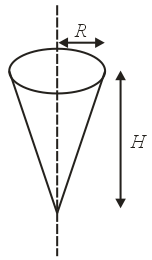
By geometry of the cone:
$$\frac{r}{R} = \frac{H-y}{H} \implies r = \frac{R}{H}(H-y)$$
$$dl = \sqrt{dy^2 + dr^2} = dy\sqrt{1 + \left(\frac{dr}{dy}\right)^2} = dy\sqrt{1 + \frac{R^2}{H^2}} = \frac{L}{H}dy \quad \text{(where } L = \sqrt{R^2+H^2}\text{)}$$
Mass element $$dm$$ of the hollow cone surface area:
$$dm = \frac{M}{\pi R L} \cdot (2\pi r \cdot dl) = \frac{2M}{RL} \cdot r \cdot \left(\frac{L}{H}dy\right) = \frac{2M}{RH} r dy$$
Using $$dy = -\frac{H}{R}dr$$ from differentiating $$y = H - \frac{H}{R}r$$:
$$dm = \frac{2M}{RH} r \left(-\frac{H}{R}dr\right) = -\frac{2M}{R^2} r dr$$
Integrating from the base vertex ($$r=0$$) to the top surface ($$r=R$$):
$$I = \int r^2 dm \implies I = \int_{0}^{R} r^2 \left(\frac{2M}{R^2} r dr\right)$$
$$I = \frac{2M}{R^2} \int_{0}^{R} r^3 dr = \frac{2M}{R^2} \left[ \frac{r^4}{4} \right]_{0}^{R} = \frac{2M}{R^2} \cdot \frac{R^4}{4} = \frac{MR^2}{2}$$
Was this solution helpful?
Create a FREE account and get:
_1.webp)

Educational materials for JEE preparation

Ask our AI anything

AI can make mistakes. Please verify important information.
AI can make mistakes. Please verify important information.
