
Join Our JEE Preparation Group
Prep with like-minded aspirants; Get access to free daily tests and study material.
Sign in
Please select an account to continue using cracku.in
↓ →
Join Our JEE Preparation Group
Prep with like-minded aspirants; Get access to free daily tests and study material.
A particle is moving in a circular path of radius a under the action of an attractive potential $$U = -\frac{k}{2r^2}$$. Its total energy is:
We are given the attractive potential energy function
$$U(r)=-\dfrac{k}{2\,r^{2}},$$
and we are told that the particle is executing uniform circular motion of radius $$a$$ under the influence of this central potential. To obtain the total mechanical energy, we must find both the kinetic energy in the circular orbit and the value of the potential energy at the orbital radius $$r=a$$.
First we need the magnitude of the central force produced by this potential. For any conservative central potential $$U(r)$$, the radial force is obtained from the relation
$$F(r)=-\dfrac{dU}{dr}.$$
We therefore differentiate $$U(r)$$ with respect to $$r$$ step by step:
We may rewrite the potential as $$U(r)=-\dfrac{k}{2}\,r^{-2}.$$ Taking the derivative,
$$\dfrac{dU}{dr}=-\dfrac{k}{2}\,\dfrac{d}{dr}\!\left(r^{-2}\right)=-\dfrac{k}{2}\left(-2r^{-3}\right)=k\,r^{-3}.$$
Hence the radial force is
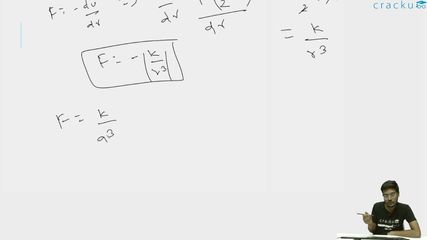
$$F(r)=-\dfrac{dU}{dr}=-\bigl(k\,r^{-3}\bigr)=-\dfrac{k}{r^{3}}.$$
The negative sign confirms that the force is attractive, i.e. directed toward the centre.
Now, for uniform circular motion of radius $$a$$, the necessary centripetal force is supplied entirely by the magnitude of this attractive central force. Therefore we impose the balance
$$\dfrac{m\,v^{2}}{a}= \left|F(a)\right|=\dfrac{k}{a^{3}},$$
where $$m$$ is the mass of the particle and $$v$$ is its constant tangential speed in the orbit. Multiplying both sides by $$a$$ gives
$$m\,v^{2}=\dfrac{k}{a^{2}}.$$
Dividing by $$m$$ to isolate $$v^{2}$$, we obtain
$$v^{2}=\dfrac{k}{m\,a^{2}}.$$
With the speed known, we can evaluate the kinetic energy $$K$$. The kinetic energy of a particle of mass $$m$$ moving with speed $$v$$ is given by the well-known formula
$$K=\dfrac{1}{2}\,m\,v^{2}.$$
Substituting the expression for $$v^{2}$$ derived above we get
$$K=\dfrac{1}{2}\,m\left(\dfrac{k}{m\,a^{2}}\right)=\dfrac{1}{2}\,\dfrac{k}{a^{2}}.$$
Next, we evaluate the potential energy at the orbital radius $$r=a$$. Simply replacing $$r$$ with $$a$$ in the given expression for $$U(r)$$, we have
$$U(a)=-\dfrac{k}{2\,a^{2}}.$$
The total mechanical energy $$E$$ of the particle is the sum of its kinetic and potential energies, so
$$E=K+U(a)=\dfrac{1}{2}\,\dfrac{k}{a^{2}}+\left(-\dfrac{k}{2\,a^{2}}\right).$$
Because the two terms are exact negatives of each other, they cancel identically:
$$E=\dfrac{1}{2}\,\dfrac{k}{a^{2}}-\dfrac{1}{2}\,\dfrac{k}{a^{2}}=0.$$
Thus the total energy of the particle in this circular orbit is zero.
Hence, the correct answer is Option D.
Was this solution helpful?
Click on the Email ☝️ to Watch the Video Solution
Create a FREE account and get:
_1.webp)

Educational materials for JEE preparation

Ask our AI anything

AI can make mistakes. Please verify important information.
AI can make mistakes. Please verify important information.
