
Join Our JEE Preparation Group
Prep with like-minded aspirants; Get access to free daily tests and study material.
Sign in
Please select an account to continue using cracku.in
↓ →
Join Our JEE Preparation Group
Prep with like-minded aspirants; Get access to free daily tests and study material.
The correct order of the following compounds showing increasing tendency towards nucleophilic substitution reaction is:
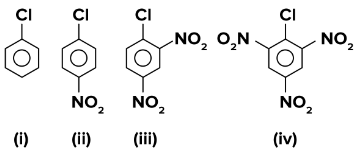
Correct Order: (i) < (ii) < (iii) < (iv)
The Core Concept: Nucleophilic Aromatic Substitution (SNAr) Normally, aryl halides (like chlorobenzene) are highly unreactive towards nucleophilic substitution. This is because the carbon-chlorine bond has partial double-bond character due to resonance, making it hard to break. Furthermore, the electron-rich benzene ring naturally repels incoming nucleophiles.
The Role of Electron-Withdrawing Groups To make an aryl halide reactive, you need strong electron-withdrawing groups (EWGs), such as the nitro group (-NO₂), attached to the ring.
Evaluating the Compounds: The tendency to undergo nucleophilic substitution increases directly with the number of electron-withdrawing -NO₂ groups at the ortho and para positions:
Therefore, the reactivity steadily increases as you add more nitro groups: (i) < (ii) < (iii) < (iv).
Was this solution helpful?
Create a FREE account and get:
_1.webp)

Educational materials for JEE preparation

Ask our AI anything

AI can make mistakes. Please verify important information.
AI can make mistakes. Please verify important information.


