
Join Our JEE Preparation Group
Prep with like-minded aspirants; Get access to free daily tests and study material.
Sign in
Please select an account to continue using cracku.in
↓ →
Join Our JEE Preparation Group
Prep with like-minded aspirants; Get access to free daily tests and study material.
Which of the following represents the lattice structure of A$$_{0.95}$$O containing A$$^{2+}$$, A$$^{3+}$$ and O$$^{2-}$$ ions?

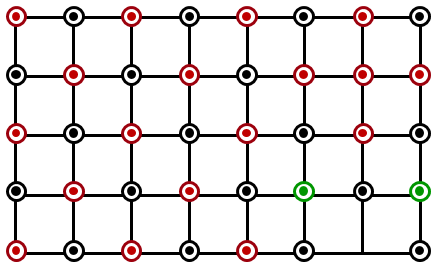
The formula $$A_{0.95}O$$ indicates a metal deficiency defect. For every oxygen ion present in the crystal, the number of metal ions is only $$0.95$$ times the number expected in a perfectly stoichiometric lattice.
The lattice shown contains 20 oxide ions $$O^{2-}$$.
Therefore, the expected number of metal ions is
$$20\times 0.95=19$$
Since there are 20 cation lattice sites but only 19 cations, the structure must contain one cation vacancy.
The total negative charge contributed by the oxide ions is
$$20\times (-2)=-40$$
For electrical neutrality, the total positive charge must be
$$+40$$
Let the number of $$A^{3+}$$ ions be $$x$$ and the number of $$A^{2+}$$ ions be $$y$$.
Since the total number of cations is 19,
$$x+y=19$$
Since the total positive charge must be 40,
$$3x+2y=40$$
Substituting
$$y=19-x$$
into the charge balance equation,
$$3x+2(19-x)=40$$
$$3x+38-2x=40$$
$$x=2$$
Therefore,
$$y=19-2=17$$
Thus, the lattice must contain
$$2\ A^{3+}\ ions$$
and
$$17\ A^{2+}\ ions$$
along with
$$1$$
cation vacancy.
The given diagram shows exactly one vacant cation site, seventeen cations of one type, and two cations of the higher oxidation state. Hence, it satisfies both the stoichiometric requirement
$$A_{0.95}O$$
and the condition of electrical neutrality.
Hence, the given diagram correctly represents the $$A_{0.95}O$$ lattice.
Was this solution helpful?
Create a FREE account and get:
_1.webp)

Educational materials for JEE preparation

Ask our AI anything

AI can make mistakes. Please verify important information.
AI can make mistakes. Please verify important information.
