
Join Our JEE Preparation Group
Prep with like-minded aspirants; Get access to free daily tests and study material.
Sign in
Please select an account to continue using cracku.in
↓ →
Join Our JEE Preparation Group
Prep with like-minded aspirants; Get access to free daily tests and study material.
Photochemical smog is formed by the reaction of nitrogen oxides (NO$$_x$$) and volatile organic compounds (VOCs) in the presence of sunlight. The key pollutants include ozone (O$$_3$$), PAN (peroxyacetyl nitrate), and formaldehyde.
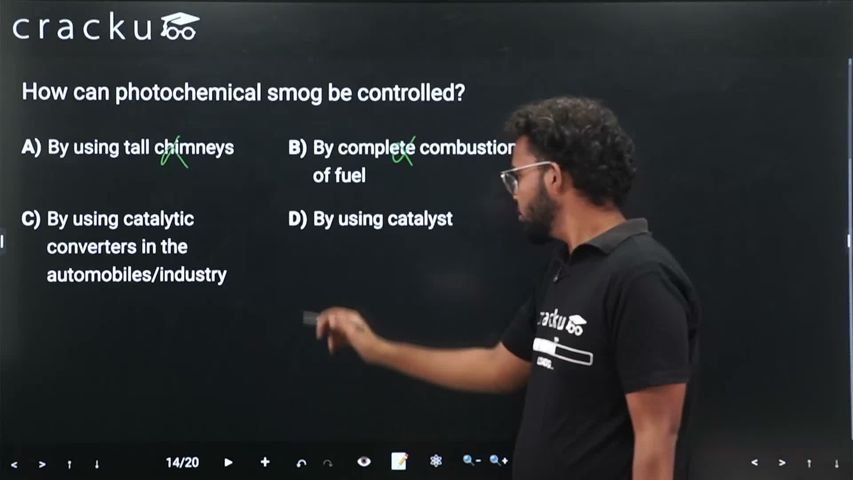
The most effective method to control photochemical smog is the use of catalytic converters in automobiles and industries. These converters transform harmful exhaust gases into less harmful products:
$$2CO + O_2 \xrightarrow{\text{catalyst}} 2CO_2$$
$$2NO_x \xrightarrow{\text{catalyst}} xO_2 + N_2$$
Unburnt hydrocarbons are also converted to CO$$_2$$ and H$$_2$$O. By reducing the emission of NO$$_x$$ and hydrocarbons at the source, catalytic converters prevent the formation of photochemical smog.
So, the answer is that photochemical smog can be controlled by using catalytic converters in automobiles and industry.
Was this solution helpful?
Click on the Email ☝️ to Watch the Video Solution
Create a FREE account and get:
_1.webp)

Educational materials for JEE preparation

Ask our AI anything

AI can make mistakes. Please verify important information.
AI can make mistakes. Please verify important information.
