
Join Our JEE Preparation Group
Prep with like-minded aspirants; Get access to free daily tests and study material.
Sign in
Please select an account to continue using cracku.in
↓ →
Join Our JEE Preparation Group
Prep with like-minded aspirants; Get access to free daily tests and study material.
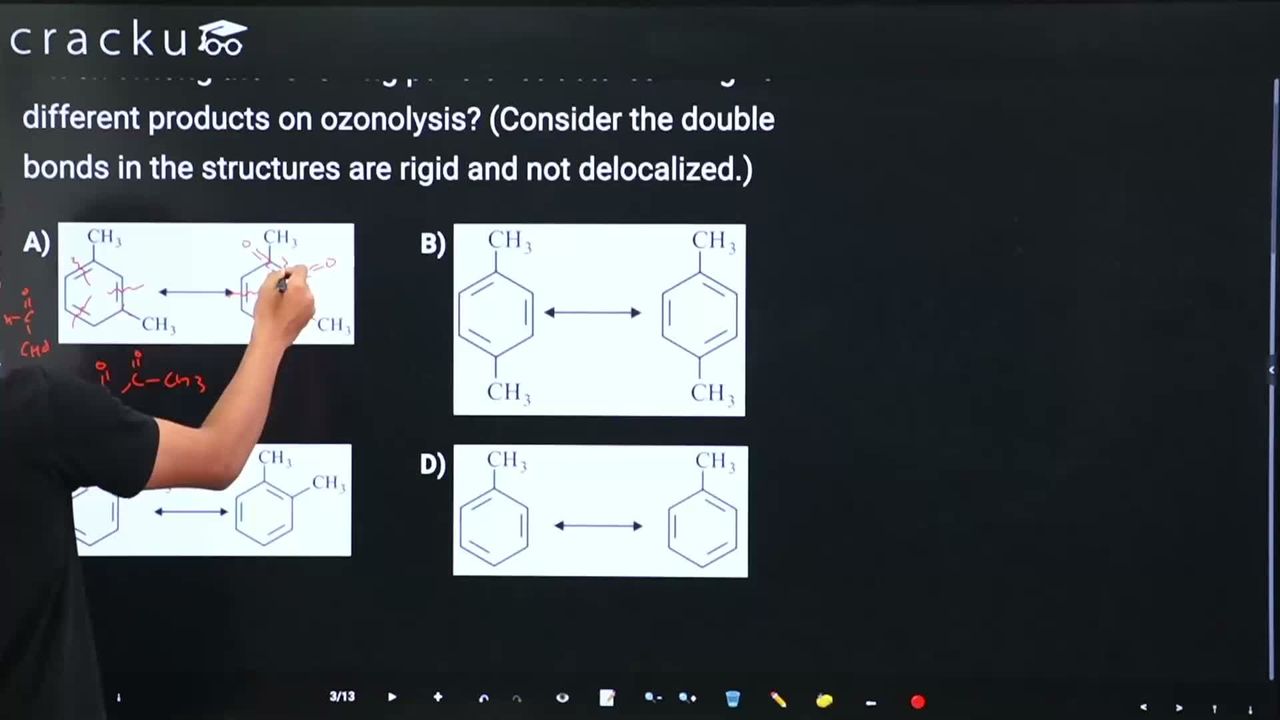
Which among the following pairs of structures will give different products on ozonolysis? (Consider the double bonds in the structures are rigid and not delocalized.)
During ozonolysis of a rigid Kekulé benzene structure, the $$\mathrm{C=C}$$ bonds are cleaved while the $$\mathrm{C-C}$$ single bonds remain intact.
The resulting two-carbon fragments depend on the substituents attached to the intact single bonds:
$$\mathrm{-CH-CH- \rightarrow Glyoxal\ (CHO-CHO)}$$
$$\mathrm{-C(CH_3)-CH- \rightarrow Methylglyoxal\ (CH_3-CO-CHO)}$$
$$\mathrm{-C(CH_3)-C(CH_3)- \rightarrow Dimethylglyoxal\ (CH_3-CO-CO-CH_3)}$$
For $$\mathrm{o\text{-}xylene}$$, the two Kekulé structures produce different fragment distributions.
In the first structure:
$$\mathrm{2\ Methylglyoxal + 1\ Glyoxal}$$
are formed.
In the second structure:
$$\mathrm{1\ Dimethylglyoxal + 2\ Glyoxal}$$
are formed.
Thus, shifting the localized double bonds changes the product distribution in $$\mathrm{o\text{-}xylene}$$.
For $$\mathrm{m\text{-}xylene}$$, $$\mathrm{p\text{-}xylene}$$, and toluene, both Kekulé structures give identical fragment distributions.
Correct Option: $$\mathrm{(C)}$$
Was this solution helpful?
Click on the Email ☝️ to Watch the Video Solution
Create a FREE account and get:
_1.webp)

Educational materials for JEE preparation

Ask our AI anything

AI can make mistakes. Please verify important information.
AI can make mistakes. Please verify important information.
