
Join Our JEE Preparation Group
Prep with like-minded aspirants; Get access to free daily tests and study material.
Sign in
Please select an account to continue using cracku.in
↓ →
Join Our JEE Preparation Group
Prep with like-minded aspirants; Get access to free daily tests and study material.
The variation of molar conductivity with concentration of an electrolyte (X) in aqueous solution is shown in the given figure.
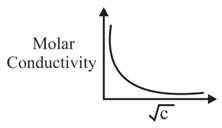
The electrolyte X is:
To identify the electrolyte represented by the given graph, we analyze the relationship between molar conductivity ($$\Lambda_m$$) and concentration.
The variation of molar conductivity with concentration is explained by Kohlrausch’s law and the Debye-Hückel-Onsager theory.
For strong electrolytes such as $$HCl$$, $$NaCl$$, and $$KNO_3$$, dissociation in solution is nearly complete. As the solution is diluted, the molar conductivity increases only gradually due to reduced interionic interactions. Consequently, the plot of $$\Lambda_m$$ versus $$\sqrt{c}$$ is almost linear and can be extrapolated to obtain the limiting molar conductivity, $$\Lambda_m^\circ$$.
In contrast, weak electrolytes such as $$CH_3COOH$$ undergo only partial dissociation. On dilution, the degree of dissociation increases significantly, causing a sharp rise in molar conductivity as the concentration approaches zero. As a result, the graph of $$\Lambda_m$$ versus $$\sqrt{c}$$ is distinctly non-linear and exhibits a steep upward curve.
The graph provided shows a pronounced, non-linear increase in molar conductivity with decreasing $$\sqrt{c}$$, which is the characteristic behavior of a weak electrolyte.
Among the given options:
Hence, the electrolyte represented by the graph is
$$\boxed{CH_3COOH}.$$
Was this solution helpful?
Create a FREE account and get:
_1.webp)

Educational materials for JEE preparation

Ask our AI anything

AI can make mistakes. Please verify important information.
AI can make mistakes. Please verify important information.
