
Join Our JEE Preparation Group
Prep with like-minded aspirants; Get access to free daily tests and study material.
Sign in
Please select an account to continue using cracku.in
↓ →
Join Our JEE Preparation Group
Prep with like-minded aspirants; Get access to free daily tests and study material.
Two short electric dipoles A and B having dipole moment p$$_1$$ and p$$_2$$ respectively are placed with their axis mutually perpendicular as shown in the figure. The resultant electric field at a point x is making an angle of 60° with the line joining points O and x. The ratio of the dipole moments p$$_2$$/p$$_1$$ is __________.
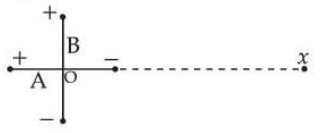
Let the two dipoles be situated at the common origin $$O$$.
Choose the axes so that
• dipole $$\vec p_1$$ points along the +$$y$$-axis
• dipole $$\vec p_2$$ points along the +$$x$$-axis.
Place the observation point $$X$$ on the +$$y$$-axis at a distance $$r$$ from the origin. Hence the line $$OX$$ coincides with the +$$y$$-axis.
Field due to dipole $$\vec p_1$$ at $$X$$
Point $$X$$ lies on the axial line of $$\vec p_1$$, so the magnitude of the electric field is
$$E_1 = \frac{1}{4\pi\varepsilon_0}\,\frac{2p_1}{r^{3}}$$
The direction of $$\vec E_1$$ is along +$$y$$ (same as $$\vec p_1$$).
Field due to dipole $$\vec p_2$$ at $$X$$
For dipole $$\vec p_2$$, point $$X$$ is on its equatorial line (perpendicular bisector), so
$$E_2 = \frac{1}{4\pi\varepsilon_0}\,\frac{p_2}{r^{3}}$$
The equatorial field is opposite to the dipole moment; hence $$\vec E_2$$ points along -$$x$$.
Resultant field
Taking +$$x$$ to the right and +$$y$$ upward:
$$\vec E_{\text{res}} = \big(-E_2\big)\hat i \;+\; E_1\hat j$$
Angle with the line $$OX$$
The line $$OX$$ is the +$$y$$-axis.
Let $$\theta = 60^\circ$$ be the angle between $$\vec E_{\text{res}}$$ and the +$$y$$-axis.
Then
$$\tan\theta = \frac{\lvert E_x\rvert}{\lvert E_y\rvert} \;=\; \frac{E_2}{E_1}$$
Substituting $$E_1$$ and $$E_2$$:
$$\tan 60^\circ = \frac{\dfrac{p_2}{4\pi\varepsilon_0 r^{3}}}{\dfrac{2p_1}{4\pi\varepsilon_0 r^{3}}} \;=\; \frac{p_2}{2p_1}$$
Since $$\tan 60^\circ = \sqrt{3}$$, we get
$$\frac{p_2}{2p_1} = \sqrt{3} \;\;\Rightarrow\;\; \frac{p_2}{p_1} = 2\sqrt{3}$$
Therefore, the required ratio is $$\displaystyle\frac{p_2}{p_1} = 2\sqrt{3}$$.
Option B which is: $$2\sqrt{3}$$
Was this solution helpful?

Click on the Email ☝️ to Watch the Video Solution
Create a FREE account and get:
_1.webp)

Educational materials for JEE preparation

Ask our AI anything

AI can make mistakes. Please verify important information.
AI can make mistakes. Please verify important information.
