
Join Our JEE Preparation Group
Prep with like-minded aspirants; Get access to free daily tests and study material.
Sign in
Please select an account to continue using cracku.in
↓ →
Join Our JEE Preparation Group
Prep with like-minded aspirants; Get access to free daily tests and study material.
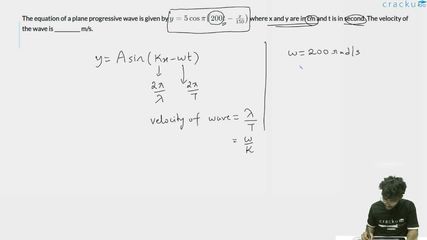
The equation of a plane progressive wave is given by $$y = 5 \cos \pi \left(200t - \frac{x}{150}\right)$$ where x and y are in cm and t is in second. The velocity of the wave is __________ m/s.
The standard form of a one-dimensional plane progressive wave travelling in the +x direction is
$$y = A \cos \left(\omega t - kx\right)$$
where $$\omega$$ is the angular frequency and $$k$$ is the angular wave number.
Given equation:
$$y = 5 \cos \pi\left(200t - \frac{x}{150}\right)\qquad (x,y \text{ in cm, } t \text{ in s})$$
Rewrite the argument to identify $$\omega$$ and $$k$$:
$$\pi\left(200t - \frac{x}{150}\right) \;=\; \bigl(\pi \cdot 200\bigr)t \;-\; \bigl(\pi/150\bigr)x$$
Therefore
$$\omega = 200\pi\ \text{rad s}^{-1}, \qquad k = \frac{\pi}{150}\ \text{rad cm}^{-1}$$
Wave speed formula:
$$v = \frac{\omega}{k}$$
Substitute the values:
$$v = \frac{200\pi}{\,\pi/150} = 200 \times 150 = 30000 \text{ cm s}^{-1}$$
Convert to SI units (1 m = 100 cm):
$$v = \frac{30000}{100} = 300 \text{ m s}^{-1}$$
Hence, the velocity of the wave is $$300\ \text{m/s}$$.
Option D which is: $$300$$
Was this solution helpful?
Click on the Email ☝️ to Watch the Video Solution
Create a FREE account and get:
_1.webp)

Educational materials for JEE preparation

Ask our AI anything

AI can make mistakes. Please verify important information.
AI can make mistakes. Please verify important information.
