
Join Our JEE Preparation Group
Prep with like-minded aspirants; Get access to free daily tests and study material.
Sign in
Please select an account to continue using cracku.in
↓ →
Join Our JEE Preparation Group
Prep with like-minded aspirants; Get access to free daily tests and study material.
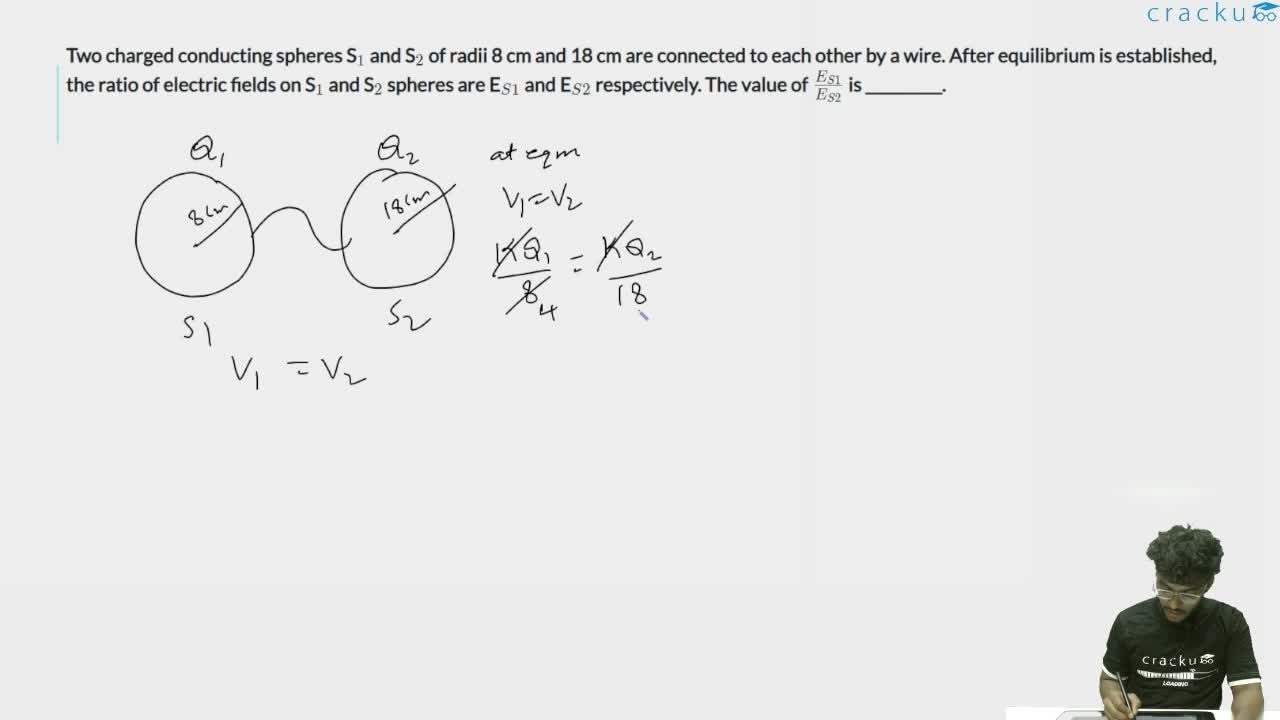
Two charged conducting spheres S$$_1$$ and S$$_2$$ of radii 8 cm and 18 cm are connected to each other by a wire. After equilibrium is established, the ratio of electric fields on S$$_1$$ and S$$_2$$ spheres are E$$_{S1}$$ and E$$_{S2}$$ respectively. The value of $$\frac{E_{S1}}{E_{S2}}$$ is __________.
When the two conducting spheres are joined by a wire, charges flow until both spheres attain the same electric potential.
Potential of a charged conducting sphere of radius $$R$$ carrying charge $$Q$$ is
$$V = \dfrac{1}{4\pi\varepsilon_0}\,\dfrac{Q}{R} \;.$$
At equilibrium:
$$V_{S1}=V_{S2}$$
$$\Rightarrow \dfrac{1}{4\pi\varepsilon_0}\,\dfrac{Q_1}{R_1}= \dfrac{1}{4\pi\varepsilon_0}\,\dfrac{Q_2}{R_2}$$
Cancelling the common factor $$\dfrac{1}{4\pi\varepsilon_0}$$ gives
$$\dfrac{Q_1}{Q_2}= \dfrac{R_1}{R_2} \;.$$
Given radii: $$R_1 = 8 \text{ cm}, \; R_2 = 18 \text{ cm}$$. Thus
$$\dfrac{Q_1}{Q_2}= \dfrac{8}{18}= \dfrac{4}{9} \;.$$
The electric field just outside the surface of a conducting sphere is
$$E = \dfrac{1}{4\pi\varepsilon_0}\,\dfrac{Q}{R^{2}} \;.$$
Hence
$$\dfrac{E_{S1}}{E_{S2}} = \dfrac{\left(\dfrac{1}{4\pi\varepsilon_0}\,\dfrac{Q_1}{R_1^{2}}\right)}{\left(\dfrac{1}{4\pi\varepsilon_0}\,\dfrac{Q_2}{R_2^{2}}\right)} = \dfrac{Q_1}{Q_2}\,\dfrac{R_2^{2}}{R_1^{2}} \;.$$
Substituting $$\dfrac{Q_1}{Q_2}= \dfrac{R_1}{R_2}$$ from the potential equality:
$$\dfrac{E_{S1}}{E_{S2}} = \left(\dfrac{R_1}{R_2}\right)\,\dfrac{R_2^{2}}{R_1^{2}} = \dfrac{R_2}{R_1} \;.$$
Finally,
$$\dfrac{E_{S1}}{E_{S2}} = \dfrac{18}{8}= \dfrac{9}{4} \;.$$
Option D which is: $$\dfrac{9}{4}$$
Click on the Email ☝️ to Watch the Video Solution
Create a FREE account and get:
_1.webp)

Educational materials for JEE preparation

Ask our AI anything

AI can make mistakes. Please verify important information.
AI can make mistakes. Please verify important information.


