
Join Our JEE Preparation Group
Prep with like-minded aspirants; Get access to free daily tests and study material.
Sign in
Please select an account to continue using cracku.in
↓ →
Join Our JEE Preparation Group
Prep with like-minded aspirants; Get access to free daily tests and study material.
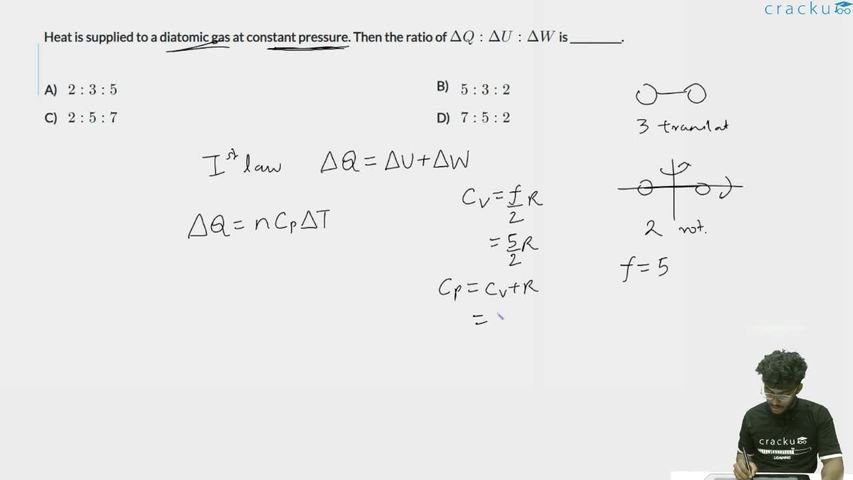
Heat is supplied to a diatomic gas at constant pressure. Then the ratio of $$\Delta Q : \Delta U : \Delta W$$ is __________.
For an ideal diatomic gas (with only translational + rotational degrees of freedom), the number of degrees of freedom is $$f = 5$$. Therefore
$$C_V = \frac{f}{2}R = \frac{5}{2}R,$$
and
$$C_P = C_V + R = \frac{5}{2}R + R = \frac{7}{2}R.$$
Let the gas contain $$n$$ moles and undergo a small temperature rise $$\Delta T$$ at constant pressure.
Heat supplied at constant pressure:
$$\Delta Q = n C_P \,\Delta T = n \left(\frac{7}{2}R\right)\Delta T.$$
Change in internal energy:
$$\Delta U = n C_V \,\Delta T = n \left(\frac{5}{2}R\right)\Delta T.$$
Work done by the gas (ideal gas, constant pressure):
$$\Delta W = P\,\Delta V = nR \,\Delta T.$$
Taking the ratio $$\Delta Q : \Delta U : \Delta W$$ and cancelling the common factors $$nR\Delta T$$, we get
$$\frac{7}{2} : \frac{5}{2} : 1 \;=\; 7 : 5 : 2.$$
Hence the required ratio is $$7:5:2$$.
Option D which is: $$7:5:2$$
Click on the Email ☝️ to Watch the Video Solution
Create a FREE account and get:
_1.webp)

Educational materials for JEE preparation

Ask our AI anything

AI can make mistakes. Please verify important information.
AI can make mistakes. Please verify important information.


