
Join Our JEE Preparation Group
Prep with like-minded aspirants; Get access to free daily tests and study material.
Sign in
Please select an account to continue using cracku.in
↓ →
Join Our JEE Preparation Group
Prep with like-minded aspirants; Get access to free daily tests and study material.
Identify the correct molecular picture showing what happens at the critical micellar concentration (CMC) of an aqueous solution of a surfactant.

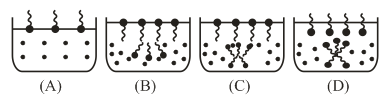
To understand what happens at the Critical Micellar Concentration (CMC), we examine the behavior of surfactant molecules in an aqueous solution.
Surfactant molecules are amphiphilic, consisting of a polar hydrophilic head and a non-polar hydrophobic tail. At concentrations below the CMC, the surfactant molecules preferentially adsorb at the air-water interface, with their hydrophilic heads immersed in water and their hydrophobic tails directed away from it. This arrangement lowers the surface tension of the solution.
As the concentration of surfactant increases, the surface eventually becomes saturated with surfactant molecules. This concentration is known as the Critical Micellar Concentration (CMC). Beyond this point, additional surfactant molecules can no longer be accommodated at the surface.
To minimize the contact between their hydrophobic tails and water, the excess surfactant molecules aggregate in the bulk solution to form micelles. In a micelle, the hydrophobic tails are oriented inward, away from water, while the hydrophilic heads remain on the outside in contact with the surrounding water.
Among the given options:
Hence, the correct representation of the system at the Critical Micellar Concentration is Option D.
Was this solution helpful?
Create a FREE account and get:
_1.webp)

Educational materials for JEE preparation

Ask our AI anything

AI can make mistakes. Please verify important information.
AI can make mistakes. Please verify important information.


