
Join Our JEE Preparation Group
Prep with like-minded aspirants; Get access to free daily tests and study material.
Sign in
Please select an account to continue using cracku.in
↓ →
Join Our JEE Preparation Group
Prep with like-minded aspirants; Get access to free daily tests and study material.
First, recall the relation that connects the standard Gibbs free energy change $$\Delta G^\circ$$ of a reaction with its enthalpy change $$\Delta H^\circ$$ and entropy change $$\Delta S^\circ$$:
$$\Delta G^\circ = \Delta H^\circ - T\,\Delta S^\circ$$
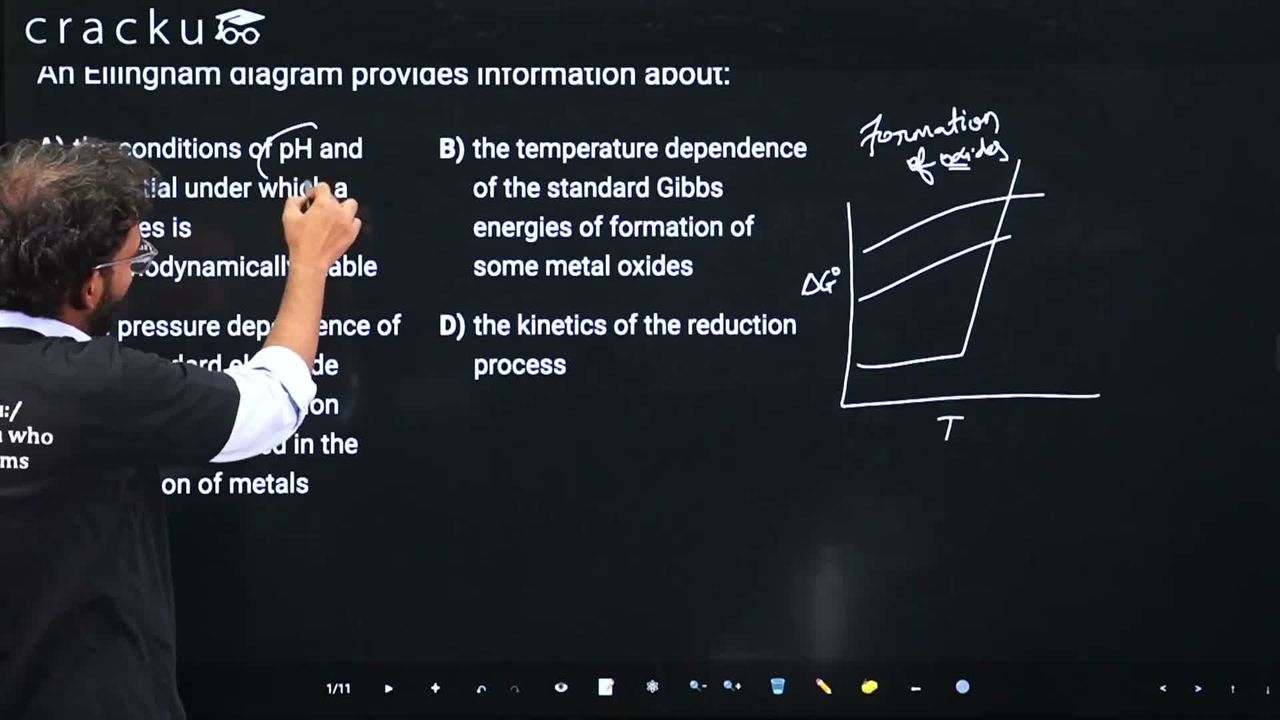
Here $$T$$ is the absolute temperature. This equation clearly shows that $$\Delta G^\circ$$ varies linearly with temperature when $$\Delta H^\circ$$ and $$\Delta S^\circ$$ are taken as temperature-independent over a limited range. Plotting $$\Delta G^\circ$$ on the y-axis against $$T$$ on the x-axis therefore gives a straight line. The slope of this line is $$-\Delta S^\circ$$ and the y-intercept is $$\Delta H^\circ$$. Such a plot for a series of oxidation reactions of metals
$$\text{Metal} + \dfrac{1}{2}\,\text{O}_2 \;\longrightarrow\; \text{Metal oxide}$$
is called an Ellingham diagram. Because each line corresponds to the formation of a particular metal oxide, the diagram directly depicts how the standard Gibbs free energy of formation of that oxide changes with temperature.
We have, therefore, that an Ellingham diagram conveys the temperature dependence of $$\Delta G_f^\circ$$ for metal oxides. It tells us at which temperature a metal oxide becomes thermodynamically unstable (i.e., when its line rises above that of another reaction, indicating that reduction becomes spontaneous). It does not give information about pH, electrode potential at various pressures, or the rate (kinetics) of the reduction.
Looking at the given options:
A. speaks of pH and potential - this is not what an Ellingham diagram shows.
B. speaks of temperature dependence of the standard Gibbs energies of formation of some metal oxides - this matches exactly.
C. refers to pressure dependence of electrode potentials - not shown by Ellingham diagrams.
D. refers to kinetics - Ellingham diagrams are purely thermodynamic, not kinetic.
Hence, the correct answer is Option 2.
Was this solution helpful?
Click on the Email ☝️ to Watch the Video Solution
Create a FREE account and get:
_1.webp)

Educational materials for JEE preparation

Ask our AI anything

AI can make mistakes. Please verify important information.
AI can make mistakes. Please verify important information.


