Join Our JEE Preparation Group
Prep with like-minded aspirants; Get access to free daily tests and study material.
Sign in
Please select an account to continue using cracku.in
↓ →
Join Our JEE Preparation Group
Prep with like-minded aspirants; Get access to free daily tests and study material.
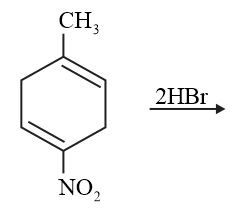
To determine the major product of the reaction, we analyze the electrophilic addition of two equivalents of hydrogen bromide $$\left(2HBr\right)$$ across the two carbon-carbon double bonds present in the ring.
The regioselectivity of each addition is governed by the stability of the carbocation intermediate formed during the reaction.
For the upper double bond, one of the carbon atoms bears a methyl group $$\left(-CH_3\right)$$. During protonation, if $$H^+$$ adds to the adjacent carbon, a tertiary carbocation is generated on the carbon carrying the methyl group. This carbocation is highly stabilized by the electron-donating inductive effect and hyperconjugation provided by the methyl substituent. On the other hand, protonation at the methyl-bearing carbon would produce a less stable secondary carbocation.
Therefore, the preferred pathway involves formation of the tertiary carbocation, followed by nucleophilic attack by $$Br^-$$. As a result, the methyl group and bromine atom become attached to the same carbon atom.
For the lower double bond, one of the carbon atoms is attached to a nitro group $$\left(-NO_2\right)$$. The nitro group is a strong electron-withdrawing substituent due to both its $$-I$$ and $$-R$$ effects. If protonation occurs at the adjacent carbon, the resulting carbocation would be located directly on the carbon bonded to the nitro group, making it highly unstable. In contrast, protonation at the nitro-substituted carbon places the positive charge on the neighbouring carbon, avoiding direct destabilization by the nitro group.
Hence, the preferred pathway is for $$H^+$$ to add to the carbon bearing the nitro group, after which $$Br^-$$ attacks the adjacent carbon.
Combining the outcomes of both additions:
Therefore, the major product is the structure in which:
This corresponds to the option D.
Create a FREE account and get:
_1.webp)

Educational materials for JEE preparation

Ask our AI anything

AI can make mistakes. Please verify important information.
AI can make mistakes. Please verify important information.