
Join Our JEE Preparation Group
Prep with like-minded aspirants; Get access to free daily tests and study material.
Sign in
Please select an account to continue using cracku.in
↓ →
Join Our JEE Preparation Group
Prep with like-minded aspirants; Get access to free daily tests and study material.
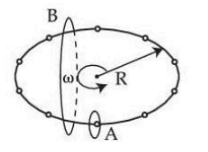
N equally spaced charges each of value q , are placed on a circle of radius R . The circle rotates about its axis with an angular velocity $$\omega$$ as shown in the figure. A bigger Amperian loop B encloses the whole circle where as a smaller Amperian loop A encloses a small segment. The difference between enclosed currents, $$I_A - I_B$$, for the given Amperian loops is
For Amperian loop B:
The loop encloses the entire plane of the rotating circle.
Every charge crossing the loop surface in one direction completes a full loop and crosses back through the enclosed area $$\implies I_B = 0$$
For Amperian loop A:
The loop encloses a small segment of the circumference.
The average current due to $$N$$ discrete rotating charges passing through this segment per unit time:
$$T = \frac{2\pi}{\omega}$$
$$I_A = \frac{Q_{\text{total}}}{T} \implies I_A = \frac{Nq}{\left(\frac{2\pi}{\omega}\right)} = \frac{N}{2\pi}qw$$
Difference between enclosed currents:
$$I_A - I_B = \frac{N}{2\pi}qw - 0 = \frac{N}{2\pi}qw$$
Was this solution helpful?
Create a FREE account and get:
_1.webp)

Educational materials for JEE preparation

Ask our AI anything

AI can make mistakes. Please verify important information.
AI can make mistakes. Please verify important information.
