
Join Our JEE Preparation Group
Prep with like-minded aspirants; Get access to free daily tests and study material.
Sign in
Please select an account to continue using cracku.in
↓ →
Join Our JEE Preparation Group
Prep with like-minded aspirants; Get access to free daily tests and study material.
Consider the following reactions:
(a) $$(CH_3)_3CCH(OH)CH_3 \xrightarrow{\text{conc.} H_2SO_4}$$
(b) $$(CH_3)_2CHCH(Br)CH_3 \xrightarrow{\text{alc. KOH}}$$
(c) $$(CH_3)_2CHCH(Br)CH_3 \xrightarrow{(CH_3)_3O^\ominus K^\oplus}$$
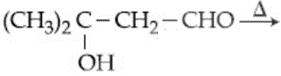
(d)
Which of the reaction(s) will not produce Saytzeff product?
Reaction (a): Acid-Catalyzed Dehydration
Dehydration of $$(CH_3)_3CCH(OH)CH_3$$ with concentrated $$\text{H}_2\text{SO}_4$$ proceeds via a carbocation intermediate. The initial secondary carbocation undergoes a 1,2-methyl shift to form a more stable tertiary carbocation, which undergoes elimination to yield the highly substituted, stable Saytzeff product ($$2,3\text{-dimethylbut-2-ene}$$).
Reaction (b): Dehydrohalogenation with a Small Base
Reaction of $$(CH_3)_2CHCH(Br)CH_3$$ with alcoholic $$\text{KOH}$$ is a classic $$\text{E2}$$ elimination. Since hydroxide ($$\text{OH}^\ominus$$) is a small, unhindered base, it preferentially abstracts the proton from the more substituted $$\beta$$-carbon to produce the thermodynamically more stable, more substituted alkene, which is the Saytzeff product ($$2\text{-methylbut-2-ene}$$).
Reaction (c): Dehydrohalogenation with a Bulky Base

Here, the substrate is treated with potassium tert-butoxide ($$(CH_3)_3\text{CO}^\ominus\text{K}^\oplus$$, printed in the text as $$(CH_3)_3\text{O}^\ominus\text{K}^\oplus$$). Because the tert-butoxide ion is a bulky, sterically hindered base, it cannot easily access the hindered internal secondary hydrogen atom. Instead, it abstract a less hindered, more accessible terminal primary proton, yielding the less substituted alkene as the major product. This is known as the Hoffmann product ($$3\text{-methylbut-1-ene}$$).
Reaction (d): Dehydration of a $$\beta$$-Hydroxy Carbonyl
Heating the $$\beta$$-hydroxy aldehyde ($$(CH_3)_2\text{C(OH)--CH}_2\text{--CHO}$$) causes elimination of water to form an $$\alpha,\beta$$-unsaturated aldehyde ($$(CH_3)_2\text{C=CH--CHO}$$). The formation of the double bond in conjugation with the carbonyl group provides strong thermodynamic stability, leading directly to the Saytzeff-like highly stable product.
Only reaction (c) yields the less substituted Hoffmann alkene as its major product due to the severe steric hindrance of the bulky base used.
Answer: Option C — (c) only
Was this solution helpful?
Click on the Email ☝️ to Watch the Video Solution
Create a FREE account and get:
_1.webp)

Educational materials for JEE preparation

Ask our AI anything

AI can make mistakes. Please verify important information.
AI can make mistakes. Please verify important information.


