
Join Our JEE Preparation Group
Prep with like-minded aspirants; Get access to free daily tests and study material.
Sign in
Please select an account to continue using cracku.in
↓ →
Join Our JEE Preparation Group
Prep with like-minded aspirants; Get access to free daily tests and study material.
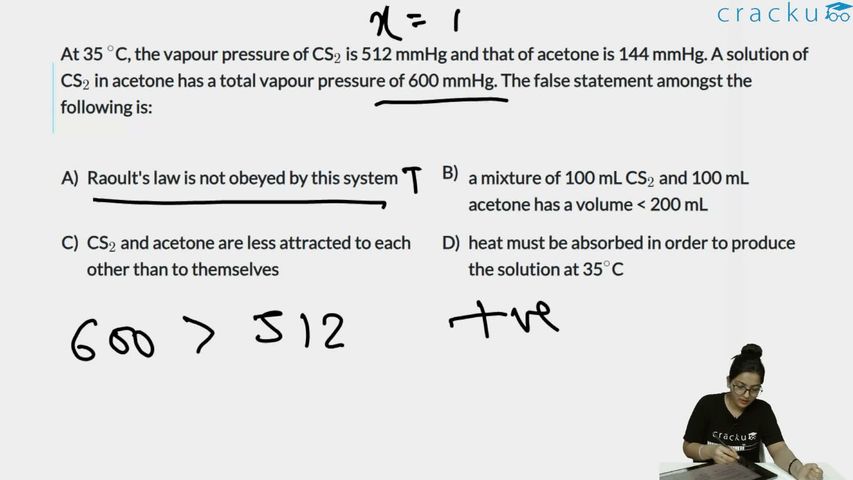
At 35 $$^\circ$$C, the vapour pressure of CS$$_2$$ is 512 mmHg and that of acetone is 144 mmHg. A solution of CS$$_2$$ in acetone has a total vapour pressure of 600 mmHg. The false statement amongst the following is:
First we recall Raoult’s law, which states that for an ideal binary solution at a given temperature the total vapour pressure is the mole-fraction-weighted sum of the vapour pressures of the pure components:
$$P_{\text{ideal}} \;=\; x_{\text{CS}_2}\,P^{\!*}_{\text{CS}_2} \;+\; x_{\text{acetone}}\,P^{\!*}_{\text{acetone}}$$
where $$x_{\text{CS}_2} + x_{\text{acetone}} = 1$$ and $$P^{\!*}_{\text{CS}_2},\;P^{\!*}_{\text{acetone}}$$ are the vapour pressures of the pure liquids.
At $$35^{\circ}\text{C}$$ we have
$$P^{\!*}_{\text{CS}_2}=512\;\text{mmHg},\qquad P^{\!*}_{\text{acetone}}=144\;\text{mmHg}$$
The experiment gives a total vapour pressure
$$P_{\text{exp}} = 600\;\text{mmHg}$$
Now we compare the experimental pressure with the maximum pressure that would be obtained if Raoult’s law were strictly obeyed. The largest possible ideal pressure occurs when the mole fraction of the more volatile component $$(\text{CS}_2)$$ is $$1$$, because this places its full pure-component pressure in the sum and gives
$$P_{\text{ideal,max}} = 1 \times 512\;\text{mmHg} + 0 \times 144\;\text{mmHg} = 512\;\text{mmHg}$$
We immediately see that
$$P_{\text{exp}} = 600\;\text{mmHg} \; > \; P_{\text{ideal,max}} = 512\;\text{mmHg}$$
So the observed pressure is larger than any pressure predicted by Raoult’s law; therefore the solution shows a positive deviation from Raoult’s law.
Consequences of a positive deviation are well known:
• The escaping tendency of both components is higher than in an ideal solution, so the components are less attracted to one another than to themselves.
• The mixing is endothermic; heat must be absorbed to form the solution.
• Because the molecules repel each other more than in an ideal case, the volume of the mixture is greater than the sum of the volumes of the pure liquids; that is, there is an expansion on mixing.
Now we examine each statement in the light of these deductions:
A. “Raoult’s law is not obeyed by this system.” We have just shown that the system exhibits a positive deviation, so the law is indeed not obeyed. Statement A is true.
B. “A mixture of 100 mL CS$$_2$$ and 100 mL acetone has a volume < 200 mL.” Positive deviation implies expansion, i.e. volume > 200 mL, not less. Hence statement B is false.
C. “CS$$_2$$ and acetone are less attracted to each other than to themselves.” Weaker unlike interactions are exactly the cause of positive deviation, so statement C is true.
D. “Heat must be absorbed in order to produce the solution at 35$$^\circ$$C.” An endothermic (heat-absorbing) mixing process accompanies positive deviation, so statement D is true.
Only statement B is in disagreement with the behaviour of a positively deviating system, therefore it is the false one.
Hence, the correct answer is Option B.
Was this solution helpful?
Click on the Email ☝️ to Watch the Video Solution
Create a FREE account and get:
_1.webp)

Educational materials for JEE preparation

Ask our AI anything

AI can make mistakes. Please verify important information.
AI can make mistakes. Please verify important information.


