
Join Our JEE Preparation Group
Prep with like-minded aspirants; Get access to free daily tests and study material.
Sign in
Please select an account to continue using cracku.in
↓ →
Join Our JEE Preparation Group
Prep with like-minded aspirants; Get access to free daily tests and study material.
Given that the standard potentials (E$$^\circ$$) of Cu$$^{2+}$$/Cu and Cu$$^+$$/Cu are 0.34V and 0.522V respectively, the E$$^\circ$$ of Cu$$^{2+}$$/Cu$$^+$$ is:
We are given two standard reduction half-reactions along with their standard reduction potentials:
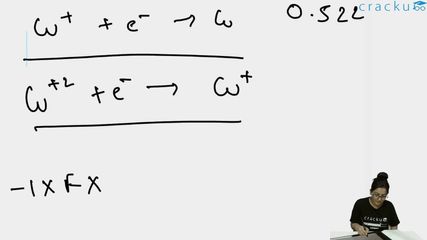
$$\text{(I)}\qquad Cu^{2+}+2e^-->Cu\ \ \ \qquad\; E_1^{\circ}=0.34\ \text{V}$$
$$\text{(II)}\qquad Cu^{+} + e^- -> Cu\ \ \ \qquad\; E_2^{\circ}=0.522\ \text{V}$$
Our target is the standard potential for the reaction
$$\text{(III)}\qquad Cu^{2+} + e^- -> Cu^{+} \qquad E^\circ_3 = ?$$
To find $$E^\circ_3$$, we recall the thermodynamic link between standard potential and standard Gibbs free energy change, which is stated by the formula
$$\Delta G^\circ = -nF E^\circ,$$
where $$n$$ is the number of electrons involved in the half-reaction and $$F$$ is Faraday’s constant. Because Gibbs free energies are additive, we can move conveniently between reactions by adding or subtracting their $$\Delta G^\circ$$ values.
First, we calculate the $$\Delta G^\circ$$ for reactions (I) and (II). For reaction (I) two electrons are transferred, so $$n = 2$$, while for reaction (II) only one electron is transferred, so $$n = 1$$.
For reaction (I):
$$\Delta G^\circ_1 = -n F E^\circ_1 = -2F \times 0.34\ \text{V} = -0.68F.$$
For reaction (II):
$$\Delta G^\circ_2 = -n F E^\circ_2 = -1F \times 0.522\ \text{V} = -0.522F.$$
Next we relate the three reactions. If we add reaction (III) to reaction (II), we should obtain reaction (I) because
$$\bigl(Cu^{2+ + e^- -> Cu^{+}}\bigr) + \bigl(Cu^{+ + e^- -> Cu}\bigr) \;=\; Cu^{2+ + 2e^- -> Cu}.$$
Therefore the Gibbs free energies must also satisfy
$$\Delta G^\circ_3 + \Delta G^\circ_2 = \Delta G^\circ_1.$$
Substituting the values we already know, we have
$$\Delta G^\circ_3 + (-0.522F) = -0.68F.$$
Now we solve for $$\Delta G^\circ_3$$ step by step:
$$\Delta G^\circ_3 = -0.68F + 0.522F = -0.158F.$$
Reaction (III) involves the transfer of exactly one electron, so for it we again set $$n = 1$$. Using the formula $$\Delta G^\circ_3 = -nF E^\circ_3$$, we obtain:
$$-0.158F = -1F \, E^\circ_3.$$
Dividing both sides by $$-F$$ gives
$$E^\circ_3 = 0.158\ \text{V}.$$
The sign is positive, so $$E^\circ(Cu^{2+/Cu^{+}}) = +0.158\ \text{V}.$$
Hence, the correct answer is Option 2.
Was this solution helpful?
Click on the Email ☝️ to Watch the Video Solution
Create a FREE account and get:
_1.webp)

Educational materials for JEE preparation

Ask our AI anything

AI can make mistakes. Please verify important information.
AI can make mistakes. Please verify important information.


