
Join Our JEE Preparation Group
Prep with like-minded aspirants; Get access to free daily tests and study material.
Sign in
Please select an account to continue using cracku.in
↓ →
Join Our JEE Preparation Group
Prep with like-minded aspirants; Get access to free daily tests and study material.
An unsaturated hydrocarbon X absorbs two hydrogen molecules on catalytic hydrogenation, and also gives following reaction:
X $$\xrightarrow[\frac{(ii) Zn}{H_2O}]{(i) O_3}$$ A $$\xrightarrow{[Ag(NH_3)_2]^+}$$ B (3-oxo-hexanedicarboxylic acid). X will be:
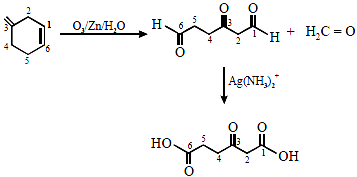
The problem states that X absorbs two moles of hydrogen ($$\text{H}_2$$) during catalytic hydrogenation. This directly tells us that X contains two carbon-carbon double bonds (a diene).
Product B is given as 3-oxo-hexanedicarboxylic acid (commonly known as 3-oxohexanedioic acid). Its chemical structure is:
$$\text{HOOC--CH}_2\text{--CH}_2\text{--C}(=\text{O})\text{--CH}_2\text{--COOH}$$
Product B is obtained by treating intermediate A with Tollens' reagent ($$[\text{Ag}(\text{NH}_3)_2]^+$$). Tollens' reagent is a mild oxidizing agent that selectively oxidizes aldehyde groups ($$-\text{CHO}$$) into carboxylic acids ($$-\text{COOH}$$) without altering ketones.
Therefore, intermediate A must be a keto-dialdehyde with the following structure:
$$\text{OHC--CH}_2\text{--CH}_2\text{--C}(=\text{O})\text{--CH}_2\text{--CHO}$$
Intermediate A is formed via the reductive ozonolysis ($$\text{O}_3\text{, then Zn/H}_2\text{O}$$) of hydrocarbon X. Ozonolysis cleaves double bonds and inserts oxygen atoms to form carbonyl compounds.
To reconstruct X, we connect the carbonyl carbons of A where the cleavage took place. Since one of the carbonyls is a ketone inside a continuous chain flanked by two aldehydes, X must be a cyclic system containing one endocyclic double bond and one exocyclic methylene ($$=\text{CH}_2$$) group:
This corresponds perfectly to 4-methylenecyclohex-1-ene.
$$\text{4-methylenecyclohex-1-ene} \xrightarrow{\text{(i) } \text{O}_3 \text{ / (ii) } \text{Zn, H}_2\text{O}} \text{OHC--CH}_2\text{--CH}_2\text{--C}(=\text{O})\text{--CH}_2\text{--CHO} + \text{HCHO}$$
$$\text{OHC--CH}_2\text{--CH}_2\text{--C}(=\text{O})\text{--CH}_2\text{--CHO} \xrightarrow{[\text{Ag}(\text{NH}_3)_2]^+} \text{HOOC--CH}_2\text{--CH}_2\text{--C}(=\text{O})\text{--CH}_2\text{--COOH}$$
The structural features match 4-methylenecyclohex-1-ene, which corresponds to the layout presented in Option C.
Answer: Option C
Was this solution helpful?
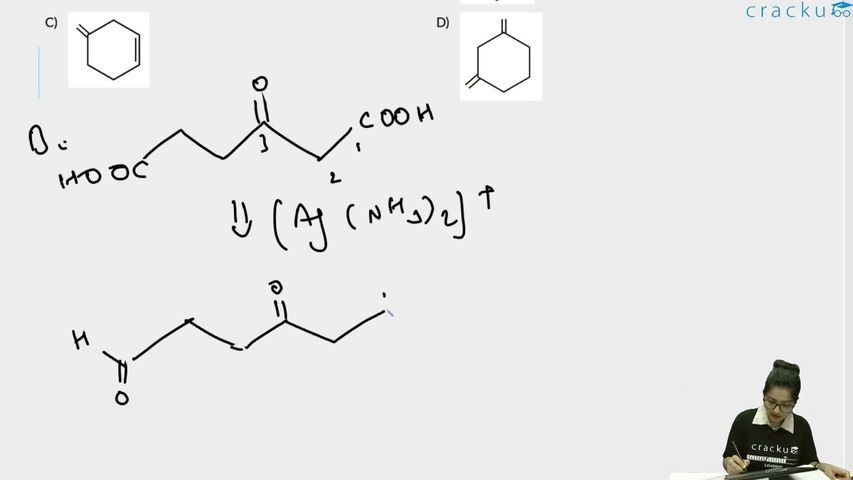
Click on the Email ☝️ to Watch the Video Solution
Create a FREE account and get:
_1.webp)

Educational materials for JEE preparation

Ask our AI anything

AI can make mistakes. Please verify important information.
AI can make mistakes. Please verify important information.


