
Join Our JEE Preparation Group
Prep with like-minded aspirants; Get access to free daily tests and study material.
Sign in
Please select an account to continue using cracku.in
↓ →
Join Our JEE Preparation Group
Prep with like-minded aspirants; Get access to free daily tests and study material.
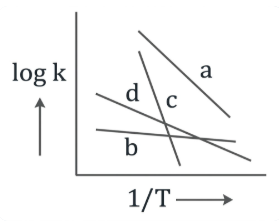
Consider the following plots of rate constant versus $$\frac{1}{T}$$ for four different reactions. Which of the following orders is correct for the activation energies of these reactions?
The logarithmic form of the Arrhenius equation is expressed as:
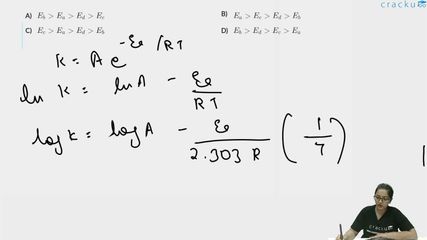
$$\log k = \log A - \frac{E_a}{2.303 R}\left(\frac{1}{T}\right)$$
When plotting $$\log k$$ on the y-axis against $$\frac{1}{T}$$ on the x-axis, the graph yields a straight line ($$y = mx + c$$) where:
Because the slope is negative ($$m = -\frac{E_a}{2.303 R}$$), the steepness of the downward incline tells us the magnitude of the activation energy:
$$\text{Magnitude of Slope } |m| = \frac{E_a}{2.303 R} \implies E_a \propto |m|$$
A steeper downward line (a larger negative slope value in terms of absolute magnitude) corresponds directly to a **higher activation energy ($$E_a$$)**.
By analyzing the steepness of the four lines in the graph from the steepest incline to the flattest:
Ordering the activation energies based on the absolute values of their slopes gives:
$$\mathbf{E_c > E_a > E_d > E_b}$$
Answer: Option C — $$E_c > E_a > E_d > E_b$$
Was this solution helpful?
Click on the Email ☝️ to Watch the Video Solution
Create a FREE account and get:
_1.webp)

Educational materials for JEE preparation

Ask our AI anything

AI can make mistakes. Please verify important information.
AI can make mistakes. Please verify important information.


