
Join Our JEE Preparation Group
Prep with like-minded aspirants; Get access to free daily tests and study material.
Sign in
Please select an account to continue using cracku.in
↓ →
Join Our JEE Preparation Group
Prep with like-minded aspirants; Get access to free daily tests and study material.
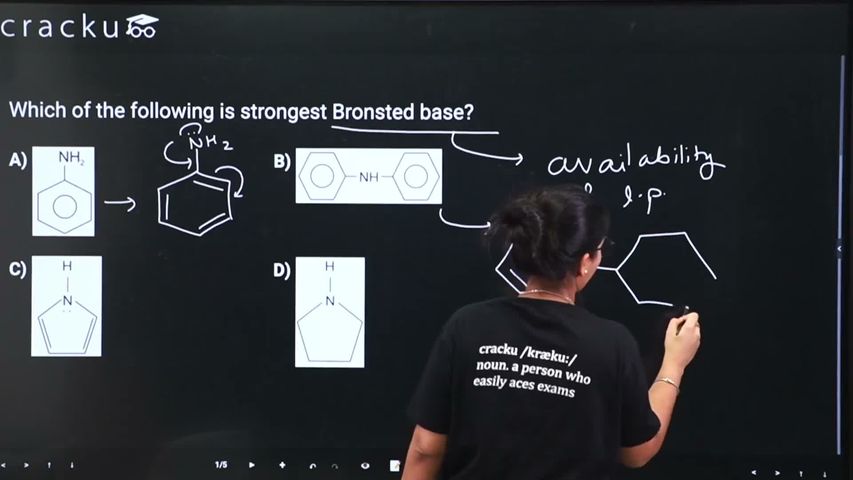
We need to identify the strongest Brønsted base among the given cyclic nitrogen-containing compounds.
Key Concept: A strong Brønsted base readily accepts a proton ($$H^+$$). The basic strength of an amine depends on the availability of the lone pair of electrons on the nitrogen atom to coordinate with a proton. If the lone pair is involved in resonance or aromaticity, it becomes less available, making the compound a weaker base.
Option A: Pyridine ($$C_5H_5N$$). In pyridine, the nitrogen atom is $$sp^2$$ hybridized. The lone pair of electrons on the nitrogen atom occupies an $$sp^2$$ hybrid orbital that lies in the plane of the ring, perpendicular to the unhybridized $$p$$ orbitals forming the aromatic $$\pi$$-system. Thus, the lone pair does not participate in aromaticity. However, because it resides in an $$sp^2$$ orbital (which has higher s-character than an $$sp^3$$ orbital), the electrons are held relatively close to the nucleus, reducing their availability compared to aliphatic amines. This is a weak base.
Option B: Aniline derivative / Quinoline / Pyrrole variant. If the option features a molecule where the lone pair is delocalized into an adjacent carbonyl group or a secondary aromatic ring system, its availability is significantly decreased due to resonance stabilization of the neutral molecule. This makes it a very weak base.
Option C: Pyrrole ($$C_4H_5N$$). In pyrrole, the lone pair of electrons on the nitrogen atom is part of the unhybridized $$p$$ orbital and participates directly in the cyclic delocalization to satisfy Huckel's rule ($$4n+2$$ electrons where $$n=1$$) for aromaticity. If pyrrole accepts a proton, its aromatic character is completely destroyed, which is highly thermodynamically unfavorable. Therefore, pyrrole is an extremely weak base.
Option D: Pyrrolidine ($$C_4H_9N$$). Pyrrolidine is a cyclic secondary aliphatic amine. The nitrogen atom is $$sp^3$$ hybridized, and its lone pair of electrons occupies an $$sp^3$$ hybrid orbital. Since there are no double bonds or conjugated systems in the ring, the lone pair is completely localized on the nitrogen atom and highly available for protonation. Furthermore, the adjacent alkyl groups exert an electron-donating inductive effect ($$+I$$ effect), which increases the electron density on the nitrogen atom, making it the strongest base among the choices.
Therefore, pyrrolidine is the strongest Brønsted base because its lone pair is fully localized in an $$sp^3$$ orbital and not involved in any resonance or aromatic stabilization.
Answer: Option D — Pyrrolidine
Was this solution helpful?
Click on the Email ☝️ to Watch the Video Solution
Create a FREE account and get:
_1.webp)

Educational materials for JEE preparation

Ask our AI anything

AI can make mistakes. Please verify important information.
AI can make mistakes. Please verify important information.
