Join Our JEE Preparation Group
Prep with like-minded aspirants; Get access to free daily tests and study material.
Sign in
Please select an account to continue using cracku.in
↓ →
Join Our JEE Preparation Group
Prep with like-minded aspirants; Get access to free daily tests and study material.
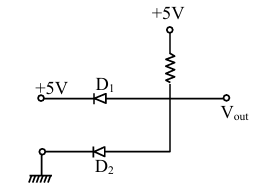
Both diodes have their p-sides connected to the central junction node ($$V_{\text{out}}$$), which is pulled up toward $$+5\text{ V}$$ via a resistor.
If $$V_{\text{out}}$$ rises above $$0\text{ V}$$, the anode of $$D_2$$ becomes more positive than its cathode ($$0\text{ V}$$). This makes diode $$D_2$$ forward-biased.
For $$D_1$$ to be forward-biased, $$V_{\text{out}}$$ would have to exceed $$+5\text{ V}$$, which is impossible since the maximum supply voltage is $$+5\text{ V}$$. Thus, diode $$D_1$$ remains reverse-biased (open circuit).
Since ideal diode $$D_2$$ is forward-biased, it acts as a perfect closed switch (short circuit) directly to the ground node:
$$V_{\text{out}} = V_{\text{ground}} = 0\text{ V}$$
The entire voltage drop of $$5\text{ V}$$ occurs across the pull-up resistor, clamping the output node securely to $$0\text{ V}$$.
Was this solution helpful?
Click on the Email ☝️ to Watch the Video Solution
Create a FREE account and get:
_1.webp)

Educational materials for JEE preparation

Ask our AI anything

AI can make mistakes. Please verify important information.
AI can make mistakes. Please verify important information.