
Join Our JEE Preparation Group
Prep with like-minded aspirants; Get access to free daily tests and study material.
Sign in
Please select an account to continue using cracku.in
↓ →
Join Our JEE Preparation Group
Prep with like-minded aspirants; Get access to free daily tests and study material.
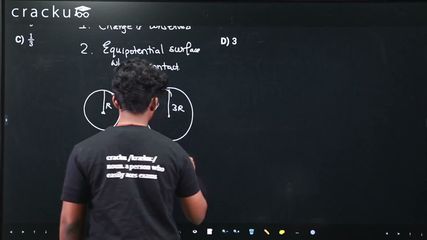
Two metal spheres of radius R and 3R have same surface charge density $$\sigma$$. If they are brought in contact and then separated, the surface charge density on smaller and bigger sphere becomes $$\sigma_1$$ and $$\sigma_2$$, respectively. The ratio $$\frac{\sigma_1}{\sigma_2}$$ is :
Let the radii of the two conducting spheres be $$R$$ (smaller) and $$3R$$ (bigger).
Both spheres initially have the same surface charge density $$\sigma$$.
Initial charges
Charge on the smaller sphere: $$Q_{s}= \sigma \times 4\pi R^{2}$$
Charge on the bigger sphere: $$Q_{b}= \sigma \times 4\pi (3R)^{2}= \sigma \times 4\pi \times 9R^{2}= 9\sigma \,4\pi R^{2}$$
Total initial charge on the system: $$Q_{\text{total}} = Q_{s}+Q_{b} = \sigma \,4\pi R^{2}(1+9)=10\sigma \,4\pi R^{2}$$
When the spheres are connected by a conducting wire, they come to the same potential. For an isolated charged sphere of radius $$r$$, the electrostatic potential is
$$V = \frac{1}{4\pi\varepsilon_0}\,\frac{Q}{r}$$
After contact, let the final charges be $$Q'_s$$ (smaller) and $$Q'_b$$ (bigger).
Equality of potentials gives
$$\frac{Q'_s}{R} = \frac{Q'_b}{3R} \;\;\Longrightarrow\;\; Q'_s = \frac{Q'_b}{3} \quad -(1)$$
Charge conservation gives
$$Q'_s + Q'_b = Q_{\text{total}} = 10\sigma \,4\pi R^{2} \quad -(2)$$
Substituting $$Q'_s$$ from $$(1)$$ into $$(2)$$:
$$\frac{Q'_b}{3} + Q'_b = 10\sigma \,4\pi R^{2}$$
$$\frac{4}{3}Q'_b = 10\sigma \,4\pi R^{2}$$
$$Q'_b = \frac{30}{4}\,\sigma \,4\pi R^{2}= \frac{15}{2}\,\sigma \,4\pi R^{2}$$
Using $$(1)$$,
$$Q'_s = \frac{Q'_b}{3}= \frac{15}{2}\times \frac{1}{3}\,\sigma \,4\pi R^{2}= \frac{5}{2}\,\sigma \,4\pi R^{2}$$
Final surface charge densities
Smaller sphere:
$$\sigma_1 = \frac{Q'_s}{4\pi R^{2}} = \frac{5}{2}\sigma$$
Bigger sphere:
$$\sigma_2 = \frac{Q'_b}{4\pi (3R)^{2}}
= \frac{\frac{15}{2}\,\sigma \,4\pi R^{2}}{4\pi \times 9R^{2}}
= \frac{15}{2}\times\frac{1}{9}\,\sigma
= \frac{5}{6}\sigma$$
Required ratio
$$\frac{\sigma_1}{\sigma_2} = \frac{\frac{5}{2}\sigma}{\frac{5}{6}\sigma} = \frac{1}{2}\times\frac{6}{1} = 3$$
The ratio $$\dfrac{\sigma_1}{\sigma_2}$$ equals 3, which matches Option D.
Was this solution helpful?
Click on the Email ☝️ to Watch the Video Solution
Create a FREE account and get:
_1.webp)

Educational materials for JEE preparation

Ask our AI anything

AI can make mistakes. Please verify important information.
AI can make mistakes. Please verify important information.
