
Join Our JEE Preparation Group
Prep with like-minded aspirants; Get access to free daily tests and study material.
Sign in
Please select an account to continue using cracku.in
↓ →
Join Our JEE Preparation Group
Prep with like-minded aspirants; Get access to free daily tests and study material.
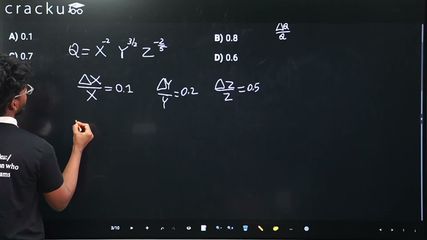
A quantity Q is formulated as $$X^{-2}Y^{+\frac{3}{2}}Z^{-\frac{2}{5}}$$. X, Y and Z are independent parameters which have fractional errors of 0.1, 0.2 and 0.5, respectively in measurement. The maximum fractional error of Q is
The quantity is $$Q = X^{-2}\,Y^{-\,\frac{3}{2}}\,Z^{\frac{2}{5}}$$.
For a physical quantity of the form $$Q = X^{a}\,Y^{b}\,Z^{c}$$, the maximum fractional (relative) error is obtained by adding the absolute contributions of each factor:
$$\frac{\Delta Q}{Q}\Big|_{\max}=|a|\;\frac{\Delta X}{X}+|b|\;\frac{\Delta Y}{Y}+|c|\;\frac{\Delta Z}{Z}$$.
Here $$a=-2,\;b=-\frac{3}{2},\;c=\frac{2}{5}$$.
Their absolute values are $$|a|=2,\;|b|=\frac{3}{2}=1.5,\;|c|=\frac{2}{5}=0.4$$.
The given fractional errors are
$$\frac{\Delta X}{X}=0.1,\qquad \frac{\Delta Y}{Y}=0.2,\qquad \frac{\Delta Z}{Z}=0.5$$.
Substituting these values:
$$\frac{\Delta Q}{Q}\Big|_{\max}=2(0.1)+1.5(0.2)+0.4(0.5)$$
Calculate each term:
$$2(0.1)=0.2,\qquad 1.5(0.2)=0.3,\qquad 0.4(0.5)=0.2$$
Add them:
$$0.2+0.3+0.2 = 0.7$$
Therefore, the maximum fractional error in $$Q$$ is $$0.7$$.
Option C is correct.
Was this solution helpful?
Click on the Email ☝️ to Watch the Video Solution
Create a FREE account and get:
_1.webp)

Educational materials for JEE preparation

Ask our AI anything

AI can make mistakes. Please verify important information.
AI can make mistakes. Please verify important information.
