
Join Our JEE Preparation Group
Prep with like-minded aspirants; Get access to free daily tests and study material.
Sign in
Please select an account to continue using cracku.in
↓ →
Join Our JEE Preparation Group
Prep with like-minded aspirants; Get access to free daily tests and study material.
A monoatomic gas having $$\gamma = \frac{5}{3}$$ is stored in a thermally insulated container and the gas is suddenly compressed to $$\left(\frac{1}{8}\right)^{\text{th}}$$ of its initial volume. The ratio of final pressure and initial pressure is :
($$\gamma$$ is the ratio of specific heats of the gas at constant pressure and at constant volume)
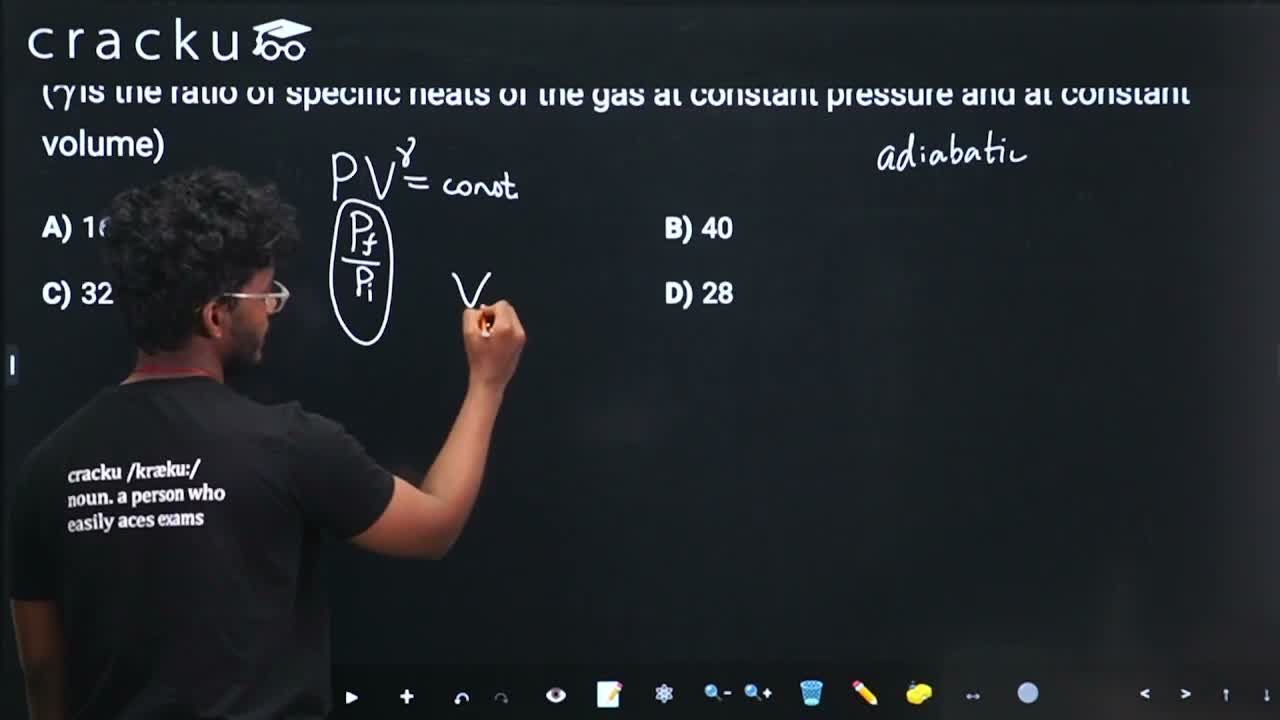
The process is sudden and the container is thermally insulated, so no heat enters or leaves the gas. Such a process is adiabatic.
For an adiabatic change in an ideal gas, the equation is
$$P V^{\gamma} = \text{constant}$$
Let the initial state be $$(P_1 , V_1)$$ and the final state be $$(P_2 , V_2)$$. Writing the adiabatic relation for the two states gives
$$P_1 V_1^{\gamma} = P_2 V_2^{\gamma}$$
Re-arrange to obtain the pressure ratio:
$$\frac{P_2}{P_1} = \left(\frac{V_1}{V_2}\right)^{\gamma}$$ $$-(1)$$
The gas is compressed to $$\left(\frac{1}{8}\right)^{\text{th}}$$ of its original volume, so
$$V_2 = \frac{V_1}{8}$$ ⇒ $$\frac{V_1}{V_2} = 8$$
Given $$\gamma = \frac{5}{3}$$ for a monoatomic gas, substitute these values in $$(1)$$:
$$\frac{P_2}{P_1} = 8^{\,\frac{5}{3}}$$
Write 8 as $$2^3$$ and simplify:
$$8^{\,\frac{5}{3}} = \left(2^3\right)^{\frac{5}{3}} = 2^{\,3 \times \frac{5}{3}} = 2^5 = 32$$
Hence the ratio of the final pressure to the initial pressure is $$32$$.
Therefore, Option C is correct.
Click on the Email ☝️ to Watch the Video Solution
Create a FREE account and get:
_1.webp)

Educational materials for JEE preparation

Ask our AI anything

AI can make mistakes. Please verify important information.
AI can make mistakes. Please verify important information.


