Join Our JEE Preparation Group
Prep with like-minded aspirants; Get access to free daily tests and study material.
Sign in
Please select an account to continue using cracku.in
↓ →
Join Our JEE Preparation Group
Prep with like-minded aspirants; Get access to free daily tests and study material.
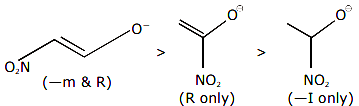
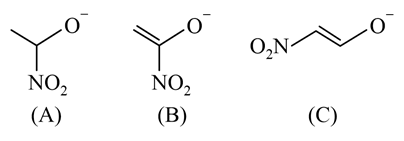
Alkoxide ions carry a negative charge on the oxygen atom ($$-\text{O}^\ominus$$). Their stability is enhanced by electron-withdrawing groups via resonance (mesomeric effect, $$-M$$) and induction ($$-I$$), which help delocalize the negative charge.
Structure (C):
The negative charge on the oxygen atom is in direct conjugation with the double bond and the nitro group ($$-\text{CH}=\text{CH}--\text{NO}_2$$). This allows the negative charge to be highly delocalized throughout the system by both resonance ($$-M$$) and inductive ($$-I$$) effects, making it the most stable alkoxide.
Structure (B):
The nitro group is attached to an $$sp^2$$ hybridized carbon atom of an isolated double bond. While it cannot delocalize the oxygen's lone pairs directly through extended resonance, it exerts a strong resonance effect on the alkene system alongside its strong inductive ($$-I$$) pull, providing intermediate stability.
Structure (A):
The nitro group is attached to a saturated $$sp^3$$ carbon atom. There is no resonance or conjugation possible for the nitro group here; it stabilizes the negative charge purely through the inductive effect ($$-I$$ only), which weakens significantly with distance. Hence, it is the least stable.
Was this solution helpful?
Click on the Email ☝️ to Watch the Video Solution
Create a FREE account and get:
_1.webp)

Educational materials for JEE preparation

Ask our AI anything

AI can make mistakes. Please verify important information.
AI can make mistakes. Please verify important information.