
Join Our JEE Preparation Group
Prep with like-minded aspirants; Get access to free daily tests and study material.
Sign in
Please select an account to continue using cracku.in
↓ →
Join Our JEE Preparation Group
Prep with like-minded aspirants; Get access to free daily tests and study material.
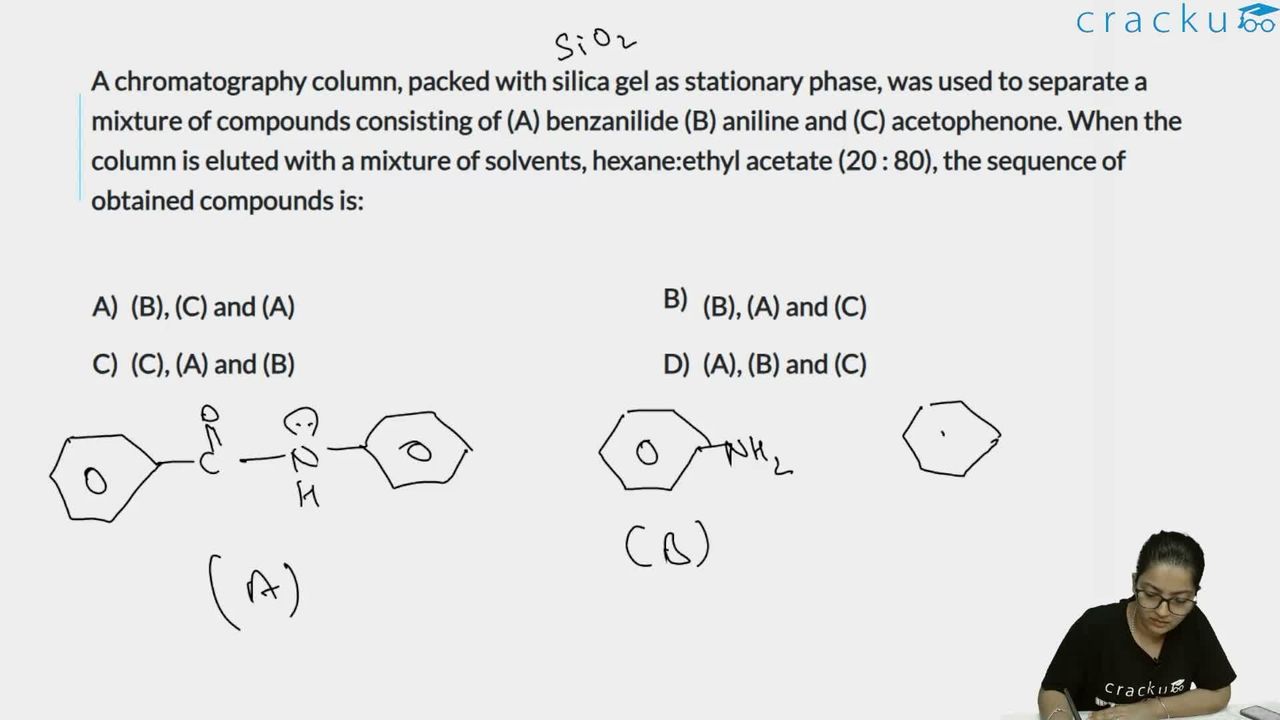
A chromatography column, packed with silica gel as stationary phase, was used to separate a mixture of compounds consisting of (A) benzanilide (B) aniline and (C) acetophenone. When the column is eluted with a mixture of solvents, hexane:ethyl acetate (20 : 80), the sequence of obtained compounds is:
In column chromatography that uses silica gel as the stationary phase, the surface of the silica bears many $$\text{Si-OH}$$ (silanol) groups. These groups are polar and weakly acidic. Compounds reaching the column therefore compete with the solvent for hydrogen-bonding or acid-base interaction sites on the silica.
The governing principle is straightforward: the stronger a compound binds to the polar silica surface, the more slowly it travels down the column. Conversely, compounds that bind only weakly are swept out first by the mobile phase. Hence, we must compare the relative strength of interaction (and therefore the effective polarity on silica) of the three given compounds.
We list each structure and its key interaction sites:
• Compound (C) acetophenone, $$C_{6}H_{5}COCH_{3}$$, contains a single carbonyl oxygen. The carbonyl oxygen is only a hydrogen-bond acceptor and cannot donate a hydrogen bond. Moreover, there are no basic lone pairs that become protonated by the acidic silica surface. Thus, interaction with silica is limited to weak dipole attractions; overall, acetophenone is the least strongly adsorbed.
• Compound (A) benzanilide, $$C_{6}H_{5}CONHC_{6}H_{5}$$, is an amide. The carbonyl oxygen can accept a hydrogen bond and the $$N-H$$ can donate one. However, the lone pair on the nitrogen is delocalised into the carbonyl group, so basicity is strongly reduced; the molecule is also sterically bulky because of two phenyl rings, which lessens surface contact. Hence, benzanilide interacts with silica more than acetophenone but less than a free amine.
• Compound (B) aniline, $$C_{6}H_{5}NH_{2}$$, possesses a free amino group. On the acidic silica surface this amino group can become partially protonated
$$RNH_2+Si-OH\ \longrightarrow\ RNH_3^+\ +\ Si-O^-$$
generating a strong ionic (acid-base) attraction in addition to hydrogen bonding. Therefore aniline is most strongly retained on silica.
Combining these observations, the adsorption (polarity) order on silica is
$$\text{aniline (B)} \;>\; \text{benzanilide (A)} \;>\; \text{acetophenone (C)}.$$
Because the stationary phase is polar and the mobile phase is the relatively polar mixture hexane : ethyl acetate (20 : 80), the compounds with weaker adsorption (lower effective polarity on silica) travel the fastest and elute first. Reversing the above order therefore gives the elution sequence:
$$\text{acetophenone (C)} \;\longrightarrow\; \text{benzanilide (A)} \;\longrightarrow\; \text{aniline (B)}.$$
Thus the column first furnishes (C), then (A), and finally (B).
Hence, the correct answer is Option C.
Was this solution helpful?
Click on the Email ☝️ to Watch the Video Solution
Create a FREE account and get:
_1.webp)

Educational materials for JEE preparation

Ask our AI anything

AI can make mistakes. Please verify important information.
AI can make mistakes. Please verify important information.
