Sign in
Please select an account to continue using cracku.in
↓ →
In a list of 7 integers, one integer, denoted as x is unknown. The other six integers are 20, 4, 10, 4,8, and 4. If the mean, median, and mode of these seven integers are arranged in increasing order, they form an arithmetic progression. The sum of all possible values of x is
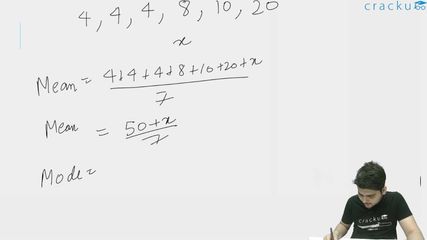
Integers = $$4,4,4,8,10,20,x$$
Clearly, irrespective of the value of $$x$$, Mode = $$4$$
Sum of above integers = $$4 + 4 + 4 + 8 + 10 + 20 + x$$
= $$50 + x$$
Mean = $$\frac{50 + x}{7}$$
Case 1 : If $$x < 4$$
Median of $$x,4,4,4,8,10,20$$ = 4
Mode = 4
Since the median and mode of the dataset are equal, they cannot be arranged in increasing order.
So this case is rejected.
Case 2 : If $$4 < x < 8$$
Median of $$4,4,4,x,8,10,20$$ = $$x$$
Mode = 4
Mean = $$\frac{50 + x}{7}$$
=> $$\frac{54}{7} < Mean < \frac{58}{7}$$
As these are in AP => $$x = 6$$ and Mean = $$8$$
Case 3 : If $$x > 8$$
Mean = $$\frac{50 + x}{7} > \frac{58}{7}$$
Median of $$4,4,4,8,x,10,20$$ = $$8$$
Mode = $$4$$
As these are in AP, => Mean = $$12$$
=> $$\frac{50 + x}{7} = 12$$
=> $$50 + x = 84$$
=> $$x = 84 - 50 = 34$$
$$\therefore$$ Sum of all possible values of x is = $$6 + 34 = 40$$
Was this solution helpful?
Click on the Email ☝️ to Watch the Video Solution
Book Free CAT Mentorship
Get personalized CAT strategy from a 99%iler
500+ students mentored
OTP Verification
Enter the 6-digit code sent to your phone
Booking Summary
Enter OTP
Didn't receive the OTP?
Start your IIM journey with the right preparation and crack CAT 2026.

Educational materials for CAT preparation

Ask our AI anything

AI can make mistakes. Please verify important information.
AI can make mistakes. Please verify important information.
 91- 6303239042