JEE WhatsApp Group
Sign in
Please select an account to continue using cracku.in
↓ →
JEE WhatsApp Group

Join Our JEE Preparation Group
Prep with like-minded aspirants; Get access to free daily tests and study material.
A uniform rod of mass m and length l is suspended by means of two identical inextensible light strings as shown in the figure. Tension in one of the strings, immediately after the other string is cut, is ____ . (g is the acceleration due to gravity)
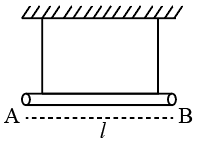
Immediately after the string at point B is cut, the rod undergoes both translation (downward acceleration a of the CM) and rotation (angular acceleration $$\alpha$$ about the CM).
$$mg - T = ma \quad \dots (1)$$
The torque is provided by the tension T at a distance $$l/2\ from\ the\ CM.$$
$$\tau = T \left( \frac{l}{2} \right) = I_{cm} \alpha$$
$$Using\ I_{cm}=\frac{1}{12}ml^2:$$
$$T\frac{l}{2}=\frac{1}{12}ml^2\alpha\Rightarrow\alpha=\frac{6T}{ml}\quad\dots(2)$$
Since the remaining string at A is inextensible, the vertical acceleration of point A must be zero ($$a_A=0$$)
$$a_A = a - \alpha \left( \frac{l}{2} \right) = 0 \implies a = \frac{\alpha l}{2}$$
$$a = \left( \frac{6T}{ml} \right) \frac{l}{2} = \frac{3T}{m} \quad \dots (3)$$
$$mg - T = m \left( \frac{3T}{m} \right)$$
$$T = \frac{mg}{4}$$
Create a FREE account and get:
_1.webp)

Educational materials for JEE preparation

Ask our AI anything

AI can make mistakes. Please verify important information.
AI can make mistakes. Please verify important information.