Join Our JEE Preparation Group
Prep with like-minded aspirants; Get access to free daily tests and study material.
Sign in
Please select an account to continue using cracku.in
↓ →
Join Our JEE Preparation Group
Prep with like-minded aspirants; Get access to free daily tests and study material.
To determine the correct class of drug for chlordiazepoxide, we must examine its therapeutic use and compare it with the given drug categories.
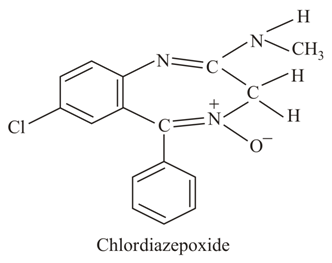
Chlordiazepoxide is a well-known synthetic compound belonging to the benzodiazepine class of drugs. It acts on the central nervous system (CNS) to produce a calming effect and is primarily prescribed for the treatment of anxiety disorders, tension, and alcohol withdrawal symptoms.
Now, let us examine each option:
(A) Analgesics
Analgesics are drugs that relieve pain without causing loss of consciousness. Examples include aspirin, paracetamol, and morphine. Chlordiazepoxide does not possess pain-relieving properties, so it does not belong to this class.
(B) Tranquillizers
Tranquillizers are drugs used to reduce anxiety, stress, irritability, and emotional tension by producing a calming effect on the central nervous system. Since chlordiazepoxide is specifically used for the treatment of anxiety and related conditions, it belongs to this category.
(C) Antacids
Antacids neutralize excess stomach acid and are used to treat conditions such as heartburn and indigestion. Common examples include magnesium hydroxide and sodium bicarbonate. Chlordiazepoxide is unrelated to gastric acid neutralization.
(D) Antibiotics
Antibiotics are substances that inhibit the growth of or destroy microorganisms and are used to treat bacterial infections. Examples include penicillin and tetracycline. Chlordiazepoxide has no antimicrobial activity.
Therefore, chlordiazepoxide is classified as a tranquillizer.
Hence, the correct answer is (B) Tranquillizers.
Was this solution helpful?
Create a FREE account and get:
_1.webp)

Educational materials for JEE preparation

Ask our AI anything

AI can make mistakes. Please verify important information.
AI can make mistakes. Please verify important information.