
Join Our JEE Preparation Group
Prep with like-minded aspirants; Get access to free daily tests and study material.
Sign in
Please select an account to continue using cracku.in
↓ →
Join Our JEE Preparation Group
Prep with like-minded aspirants; Get access to free daily tests and study material.
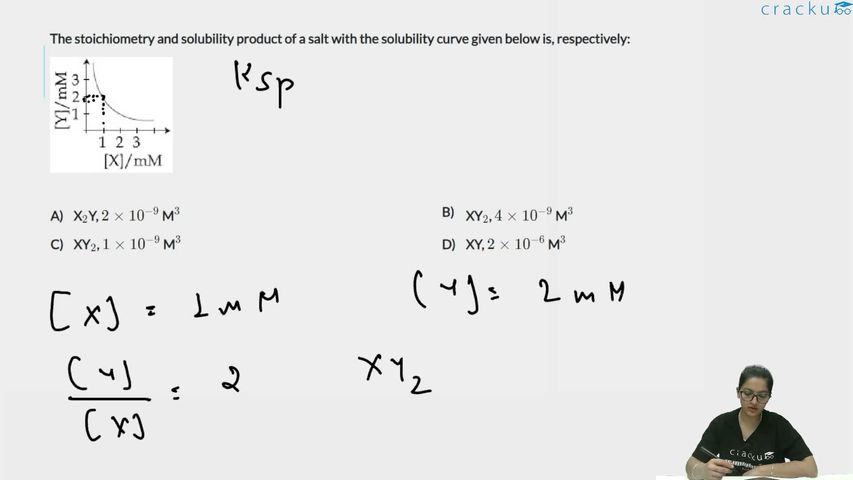
The stoichiometry and solubility product of a salt with the solubility curve given below is, respectively:
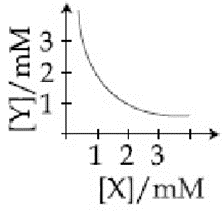
By examining the equilibrium curve, we can identify a distinct, well-defined point where the concentrations of both ions intersect cleanly at integer grid marks:
The ratio of the molar concentrations of the ions in the saturated solution gives the stoichiometric coefficients of the salt formula:
$$\frac{[\text{Y}]}{[\text{X}]} = \frac{2\text{ mM}}{1\text{ mM}} = 2$$
This means that for every 1 mole of $$\text{X}$$ ions that dissolves, 2 moles of $$\text{Y}$$ ions are released into the solution. Therefore, the empirical formula of the salt is $$\text{XY}_2$$.
The dissolution equation for the salt $$\text{XY}_2$$ is written as:
$$\text{XY}_2(s) \rightleftharpoons \text{X}^{2+}(aq) + 2\text{Y}^-(aq)$$
The expression for its solubility product constant ($$K_{sp}$$) is:
$$K_{sp} = [\text{X}][\text{Y}]^2$$
Substituting the equilibrium concentration values from Step 1 into the expression:
$$K_{sp} = \left(1 \times 10^{-3}\text{ M}\right) \times \left(2 \times 10^{-3}\text{ M}\right)^2$$
$$K_{sp} = \left(1 \times 10^{-3}\right) \times \left(4 \times 10^{-6}\right)$$
$$K_{sp} = 4 \times 10^{-9}\text{ M}^3$$
The stoichiometry corresponds to $$\text{XY}_2$$ and the calculated solubility product is $$4 \times 10^{-9}\text{ M}^3$$.
Answer: Option B — $$\text{XY}_2, 4 \times 10^{-9}\text{ M}^3$$
Was this solution helpful?
Click on the Email ☝️ to Watch the Video Solution
Create a FREE account and get:
_1.webp)

Educational materials for JEE preparation

Ask our AI anything

AI can make mistakes. Please verify important information.
AI can make mistakes. Please verify important information.
