
Join Our JEE Preparation Group
Prep with like-minded aspirants; Get access to free daily tests and study material.
Sign in
Please select an account to continue using cracku.in
↓ →
Join Our JEE Preparation Group
Prep with like-minded aspirants; Get access to free daily tests and study material.
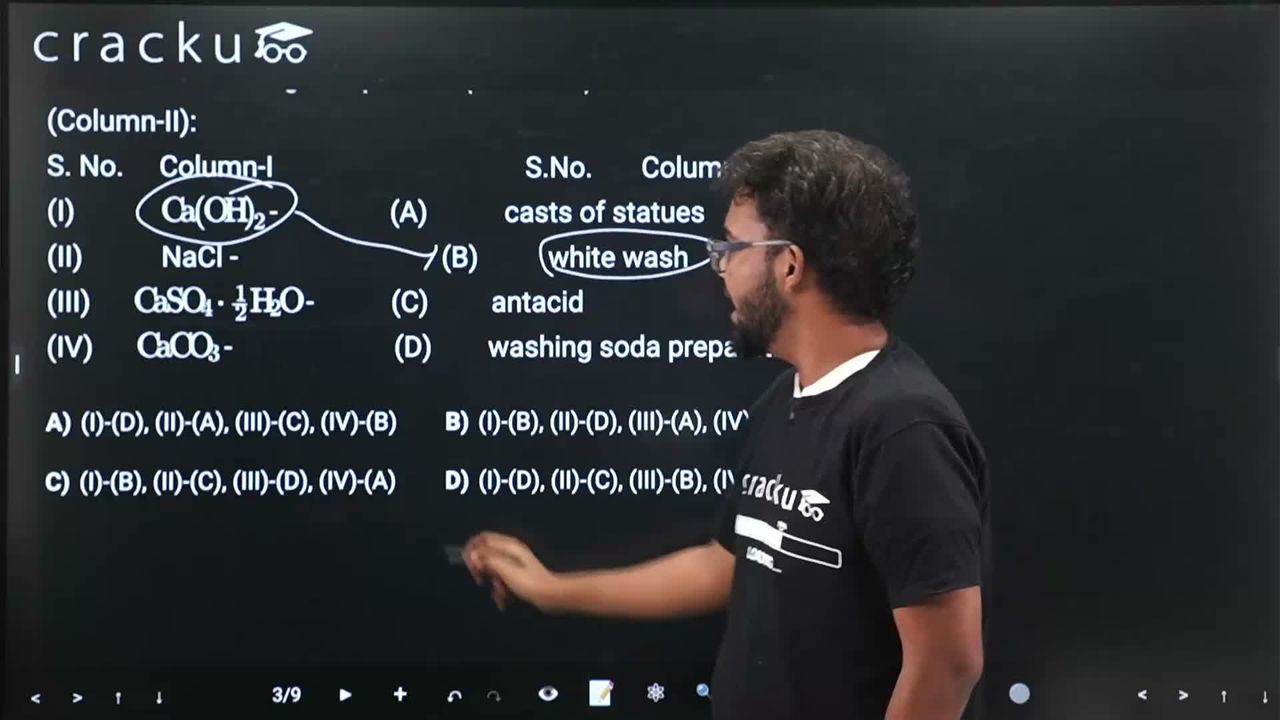
Match the following compounds (Column-I) with their uses (Column-II):
S. No. Column-I S.No. Column-II
(I) $$\text{Ca(OH)}_2$$ - (A) casts of statues
(II) NaCl - (B) white wash
(III) $$\text{CaSO}_4 \cdot \frac{1}{2}\text{H}_2\text{O}$$ - (C) antacid
(IV) $$\text{CaCO}_3$$ - (D) washing soda preparation
First let us consider the compound $$\text{Ca(OH)}_2$$, commonly called calcium hydroxide or lime. It is mixed with water to obtain “lime-wash” that is painted on walls for its disinfecting and whitening action. Thus its principal use is white-wash, denoted in Column-II by (B).
Next we take $$\text{NaCl}$$, ordinary common salt. In the Solvay process for manufacturing washing soda $$\text{Na}_2\text{CO}_3$$, brine, which is essentially an aqueous solution of $$\text{NaCl}$$, is the basic raw material. Therefore the use that fits sodium chloride is “washing soda preparation”, labelled (D).
Now examine $$\text{CaSO}_4\cdot\dfrac12\text{H}_2\text{O}$$, known as plaster of Paris. When moistened it sets quickly into a hard mass and is widely employed for making casts of statues, models and for setting fractured bones. Hence its use corresponds to “casts of statues”, marked (A).
Finally we look at $$\text{CaCO}_3$$, calcium carbonate. Finely powdered or tablet forms of this substance are taken by patients to neutralise excess gastric acid because $$\text{CaCO}_3$$ reacts with $$\text{HCl}$$ in the stomach to form neutral $$\text{CaCl}_2$$, water and carbon dioxide. Therefore its application is as an antacid, indicated by (C).
Collecting all these correct pairings we have:
$$\text{Ca(OH)}_2 \rightarrow \text{(B) white wash}$$
$$\text{NaCl} \rightarrow \text{(D) washing soda preparation}$$
$$\text{CaSO}_4\cdot\dfrac12\text{H}_2\text{O} \rightarrow \text{(A) casts of statues}$$
$$\text{CaCO}_3 \rightarrow \text{(C) antacid}$$
This sequence matches exactly with Option B.
Hence, the correct answer is Option B.
Was this solution helpful?
Click on the Email ☝️ to Watch the Video Solution
Create a FREE account and get:
_1.webp)

Educational materials for JEE preparation

Ask our AI anything

AI can make mistakes. Please verify important information.
AI can make mistakes. Please verify important information.


