
Join Our JEE Preparation Group
Prep with like-minded aspirants; Get access to free daily tests and study material.
Sign in
Please select an account to continue using cracku.in
↓ →
Join Our JEE Preparation Group
Prep with like-minded aspirants; Get access to free daily tests and study material.
List-I shows four configurations, each consisting of a pair of ideal electric dipoles. Each dipole has a dipole moment of magnitude $$p$$, oriented as marked by arrows in the figures. In all the configurations the dipoles are fixed such that they are at a distance $$2r$$ apart along the $$x$$ direction. The midpoint of the line joining the two dipoles is $$X$$. The possible resultant electric fields $$\vec{E}$$ at $$X$$ are given in List-II.
Choose the option that describes the correct match between the entries in List-I to those in List-II.
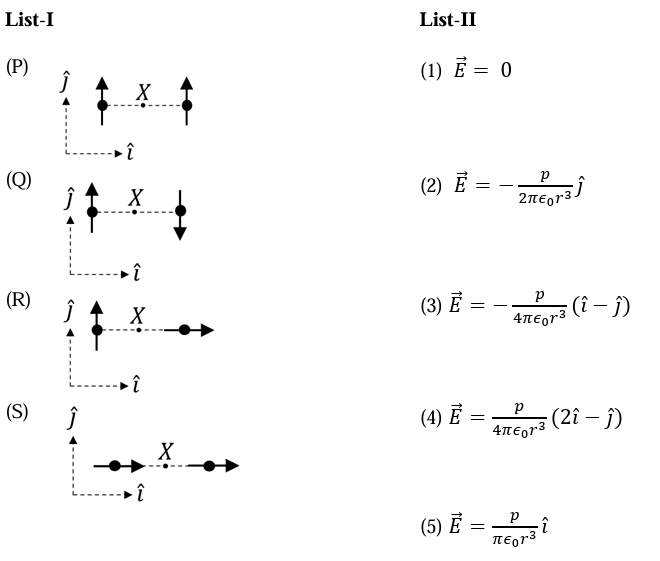
$$\text{Distance from each dipole to midpoint } X = r$$
$$\vec{E}_{\text{axial}} = \frac{2p}{4\pi\varepsilon_0 r^3}\hat{u}_{\text{axial}}, \quad \vec{E}_{\text{equatorial}} = -\frac{p}{4\pi\varepsilon_0 r^3}\hat{u}_{\text{equatorial}}$$
Evaluating entry (P):
$$\vec{p}_1 = p\hat{j} \quad (\text{equatorial at } X) \implies \vec{E}_1 = -\frac{p}{4\pi\varepsilon_0 r^3}\hat{j}$$
$$\vec{p}_2 = p\hat{j} \quad (\text{equatorial at } X) \implies \vec{E}_2 = -\frac{p}{4\pi\varepsilon_0 r^3}\hat{j}$$
$$\vec{E}_X = \vec{E}_1 + \vec{E}_2 = -\frac{p}{2\pi\varepsilon_0 r^3}\hat{j} \implies \text{(P)} \rightarrow \text{(2)}$$
Evaluating entry (Q):
$$\vec{p}_1 = p\hat{j} \quad (\text{equatorial at } X) \implies \vec{E}_1 = -\frac{p}{4\pi\varepsilon_0 r^3}\hat{j}$$
$$\vec{p}_2 = -p\hat{j} \quad (\text{equatorial at } X) \implies \vec{E}_2 = -\frac{-p}{4\pi\varepsilon_0 r^3}\hat{j} = \frac{p}{4\pi\varepsilon_0 r^3}\hat{j}$$
$$\vec{E}_X = \vec{E}_1 + \vec{E}_2 = 0 \implies \text{(Q)} \rightarrow \text{(1)}$$
Evaluating entry (R):
$$\vec{p}_1 = p\hat{j} \quad (\text{equatorial at } X) \implies \vec{E}_1 = -\frac{p}{4\pi\varepsilon_0 r^3}\hat{j}$$
$$\vec{p}_2 = p\hat{i} \quad (\text{axial at } X) \implies \vec{E}_2 = \frac{2p}{4\pi\varepsilon_0 r^3}\hat{i}$$
$$\vec{E}_X = \vec{E}_1 + \vec{E}_2 = \frac{p}{4\pi\varepsilon_0 r^3}(2\hat{i} - \hat{j}) \implies \text{(R)} \rightarrow \text{(4)}$$
Evaluating entry (S):
$$\vec{p}_1 = p\hat{i} \quad (\text{axial at } X) \implies \vec{E}_1 = \frac{2p}{4\pi\varepsilon_0 r^3}\hat{i}$$
$$\vec{p}_2 = p\hat{i} \quad (\text{axial at } X) \implies \vec{E}_2 = \frac{2p}{4\pi\varepsilon_0 r^3}\hat{i}$$
$$\vec{E}_X = \vec{E}_1 + \vec{E}_2 = \frac{p}{\pi\varepsilon_0 r^3}\hat{i} \implies \text{(S)} \rightarrow \text{(5)}$$
Was this solution helpful?
Create a FREE account and get:
_1.webp)

Educational materials for JEE preparation

Ask our AI anything

AI can make mistakes. Please verify important information.
AI can make mistakes. Please verify important information.
