
Join Our JEE Preparation Group
Prep with like-minded aspirants; Get access to free daily tests and study material.
Sign in
Please select an account to continue using cracku.in
↓ →
Join Our JEE Preparation Group
Prep with like-minded aspirants; Get access to free daily tests and study material.
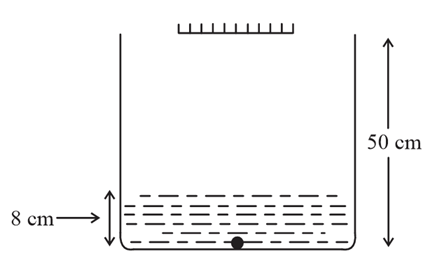
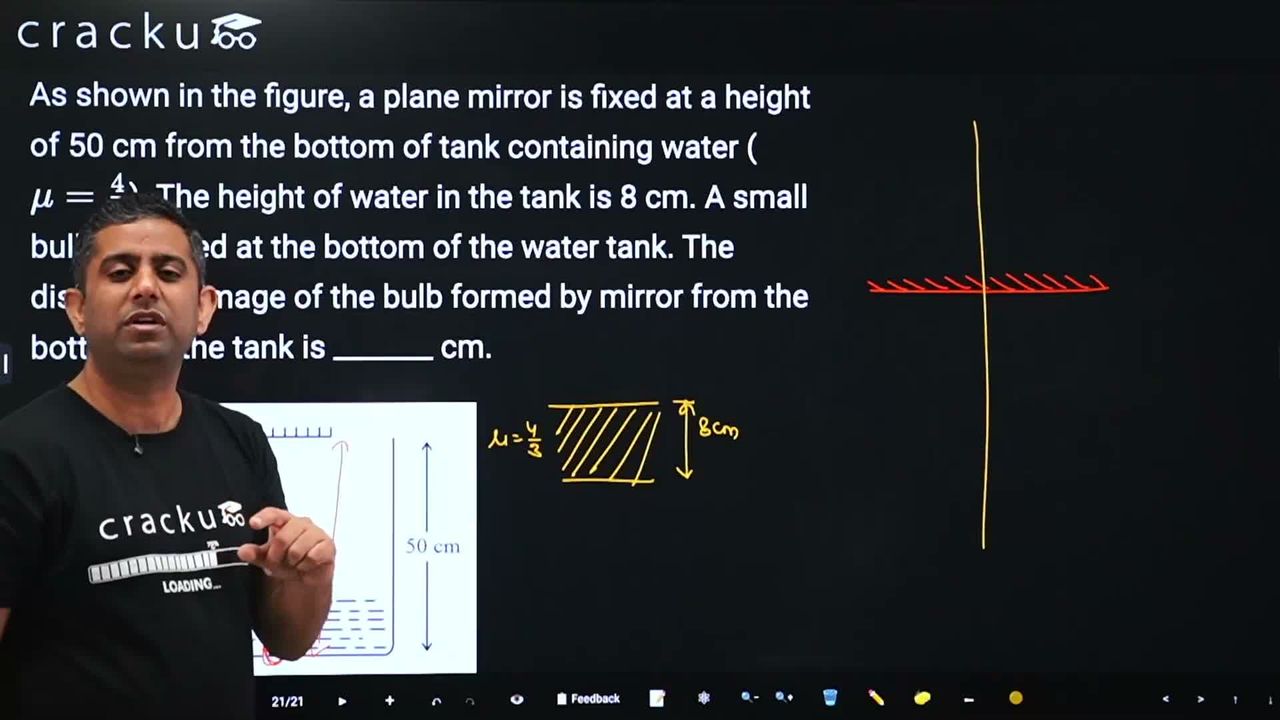
As shown in the figure, a plane mirror is fixed at a height of 50 cm from the bottom of tank containing water ($$\mu = \frac{4}{3}$$). The height of water in the tank is 8 cm. A small bulb is placed at the bottom of the water tank. The distance of image of the bulb formed by mirror from the bottom of the tank is _______ cm.
Correct Answer: 98
$$\text{Apparent depth of the bulb when viewed from air above the water: } d_{\text{apparent}} = \frac{d_{\text{real}}}{\mu} = \frac{8}{4/3} = 6\text{ cm}$$
$$\text{Apparent shift upward: } \Delta x = d_{\text{real}} - d_{\text{apparent}} = 8 - 6 = 2\text{ cm}$$
$$\text{Effective distance from the bottom of the tank to the mirror: } H = 50\text{ cm}$$
$$\text{Effective object distance from the mirror: } u = H - \Delta x = 50 - 2 = 48\text{ cm}$$
$$\text{Since image distance equals object distance for a plane mirror, the image forms }48\text{ cm behind the mirror.}$$
$$\text{Distance of the image from the bottom of the tank: } D = H + v = 50 + 48 = 98\text{ cm}$$
Was this solution helpful?
Click on the Email ☝️ to Watch the Video Solution
Create a FREE account and get:
_1.webp)

Educational materials for JEE preparation

Ask our AI anything

AI can make mistakes. Please verify important information.
AI can make mistakes. Please verify important information.


