
Join Our JEE Preparation Group
Prep with like-minded aspirants; Get access to free daily tests and study material.
Sign in
Please select an account to continue using cracku.in
↓ →
Join Our JEE Preparation Group
Prep with like-minded aspirants; Get access to free daily tests and study material.
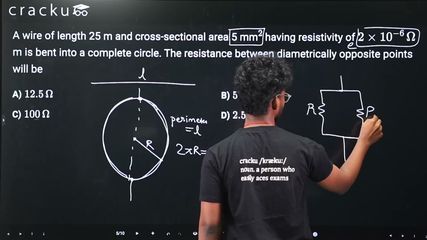
A wire of length 25 m and cross-sectional area 5 mm$$^2$$ having resistivity of $$2 \times 10^{-6}\,\Omega$$ m is bent into a complete circle. The resistance between diametrically opposite points will be
$$ R_{total} = \rho \frac{L}{A} $$
$$ R_{total} = (2 \times 10^{-6}) \times \frac{25}{5 \times 10^{-6}} $$
$$ R_{total} = 2 \times \frac{25}{5} $$
$$ R_{total} = 2 \times 5 $$
$$ R_{total} = 10\ \Omega $$
The wire is now bent into a complete circle. When calculating the resistance between two diametrically opposite points, these points divide the circular wire into two equal semicircular halves.
The resistance of each half will be exactly half of the total resistance:
$$ R_1 = R_2 = \frac{R_{total}}{2} = \frac{10}{2} = 5\ \Omega $$
These two halves act as two resistors connected in parallel between the diametrically opposite points.
The equivalent resistance ($$ R_{eq} $$) for two resistors in parallel is given by:
$$ \frac{1}{R_{eq}} = \frac{1}{R_1} + \frac{1}{R_2} $$
$$ R_{eq} = \frac{R_1 \times R_2}{R_1 + R_2} $$
$$ R_{eq} = \frac{5 \times 5}{5 + 5} $$
$$ R_{eq} = \frac{25}{10} $$
$$ R_{eq} = 2.5\ \Omega $$
Was this solution helpful?
Click on the Email ☝️ to Watch the Video Solution
Create a FREE account and get:
_1.webp)

Educational materials for JEE preparation

Ask our AI anything

AI can make mistakes. Please verify important information.
AI can make mistakes. Please verify important information.


