
Join Our JEE Preparation Group
Prep with like-minded aspirants; Get access to free daily tests and study material.
Sign in
Please select an account to continue using cracku.in
↓ →
Join Our JEE Preparation Group
Prep with like-minded aspirants; Get access to free daily tests and study material.
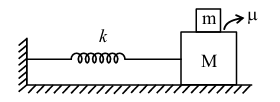
Two blocks of masses m and M, $$(M \gt m)$$, are placed on a frictionless table as shown in figure. A massless spring with spring constant k is attached with the lower block. If the system is slightly displaced and released then ($$\mu$$ = coefficient of friction between the two blocks)
(A) The time period of small oscillation of the two blocks is $$T = 2\pi\sqrt{\frac{m+M}{k}}$$
(B) The acceleration of the blocks is $$a = \frac{kx}{M+m}$$
(C) The magnitude of the frictional force on upper block is $$\frac{m\mu|x|}{M+m}$$
(D) The maximum amplitude of the upper block, if it does not slip, is $$\frac{\mu(M+m)g}{k}$$
(E) Maximum frictional force can be $$\mu(M+m)g$$.
Choose the correct answer from the options given below :
Treat both blocks as one system (if no slipping occurs).
Total mass
M+m
Restoring force by spring:
F=−kx
So equation of motion is
$$(M+m)a=-kx$$
Thus
$$a=-\frac{kx}{M+m}$$
So (B) is correct.
For SHM,
$$\omega=\sqrt{\frac{k}{M+m}}$$
Hence
$$T=2\pi\sqrt{\frac{M+m}{k}}$$
So (A) is correct.
For upper block m, only horizontal force is friction.
It must provide acceleration
$$a=\frac{kx}{M+m}$$
Therefore friction needed is
$$f=ma$$
$$f=\frac{mkx}{M+m}$$
So (C) is wrong
For no slipping,
required friction must not exceed maximum static friction:
$$\frac{mkA}{M+m}\le\mu mg$$
Cancel m:
$$\frac{kA}{M+m}\le\mu g$$
Thus maximum amplitude
$$A_{\max}=\frac{\mu(M+m)g}{k}$$
So (D) is correct.
Now (E):
Maximum possible friction between blocks is
$$f_{\max}=\mu N$$
Normal reaction is only due to upper block’s weight:
N=mg
So
$$f_{\max}=\mu mg$$
So (E) is false.
Was this solution helpful?
Click on the Email ☝️ to Watch the Video Solution
Create a FREE account and get:
_1.webp)

Educational materials for JEE preparation

Ask our AI anything

AI can make mistakes. Please verify important information.
AI can make mistakes. Please verify important information.


