
Join Our JEE Preparation Group
Prep with like-minded aspirants; Get access to free daily tests and study material.
Sign in
Please select an account to continue using cracku.in
↓ →
Join Our JEE Preparation Group
Prep with like-minded aspirants; Get access to free daily tests and study material.
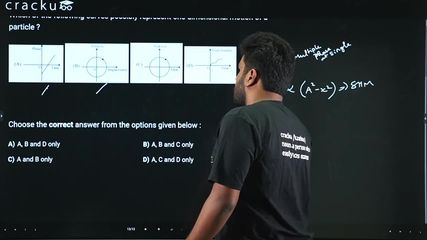
Which of the following curves possibly represent one-dimensional motion of a particle ?
Choose the correct answer from the options given below :
Let’s check each graph using basic rules of 1D motion.
Key idea: for any physical motion, at a given time there must be a unique value of position/velocity/etc. Also, graphs must satisfy physical definitions (like velocity = dx/dt, distance can’t decrease, etc.)
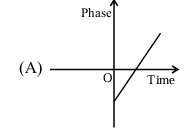
(A) Phase vs Time (straight line)
Phase increasing linearly with time is possible (like uniform motion in SHM phase representation).
No contradiction → valid.
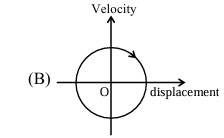
(B) Velocity vs Displacement (circle)
This can represent motion like SHM where
$$v^2\propto(A^2-x^2)$$
which gives a circular/elliptic relation.
For each displacement, two velocities (forward/backward) are allowed → physically valid.
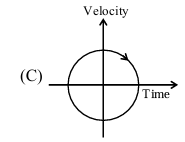
(C) Velocity vs Time (circle)
This is not possible.
At a given time, velocity must have a single value.
But a circle gives two velocities for the same time → violates definition.
So invalid.
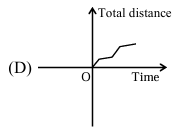
(D) Total distance vs Time
Total distance must:
The graph shown is non-decreasing → valid.
Final answer:
A, B and D only
(C is not possible because it gives multiple velocities at the same time)
Was this solution helpful?
Click on the Email ☝️ to Watch the Video Solution
Create a FREE account and get:
_1.webp)

Educational materials for JEE preparation

Ask our AI anything

AI can make mistakes. Please verify important information.
AI can make mistakes. Please verify important information.


