
Join Our JEE Preparation Group
Prep with like-minded aspirants; Get access to free daily tests and study material.
Sign in
Please select an account to continue using cracku.in
↓ →
Join Our JEE Preparation Group
Prep with like-minded aspirants; Get access to free daily tests and study material.
A uniform metal chain of mass $$m$$ and length $$L$$ passes over a massless and frictionless pulley. It is released from rest with a part of its length $$l$$ is hanging on one side and rest of its length $$(L-l)$$ is hanging on the other side of the pulley. At a certain point of time, when $$l = \frac{L}{x}$$, the acceleration of the chain is $$\frac{g}{2}$$. The value of $$x$$ is
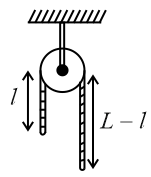
Let the linear mass density of the chain be λ. Since the chain is uniform, it is given by:
At the given point in time:
Assuming the longer side (L - l) moves downward, the net driving force (Fnet) on the chain is the difference between the gravitational forces acting on both sides:
The total mass being accelerated is the entire mass of the chain, m = λL.
Using Newton's second law (Fnet = m · a):
We are given that when l = L / x, the acceleration of the chain is a = g / 2. Substituting these into our acceleration equation:
Cancel out g from both sides:
Rearranging the terms to solve for x:
The value of x is 4. Therefore, the correct option is 4.
```
Was this solution helpful?
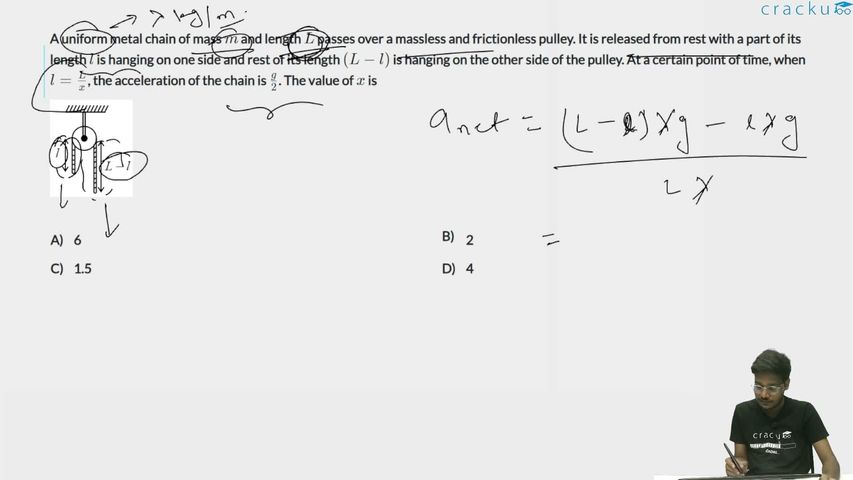
Click on the Email ☝️ to Watch the Video Solution
Create a FREE account and get:
_1.webp)

Educational materials for JEE preparation

Ask our AI anything

AI can make mistakes. Please verify important information.
AI can make mistakes. Please verify important information.
