
Join Our JEE Preparation Group
Prep with like-minded aspirants; Get access to free daily tests and study material.
Sign in
Please select an account to continue using cracku.in
↓ →
Join Our JEE Preparation Group
Prep with like-minded aspirants; Get access to free daily tests and study material.
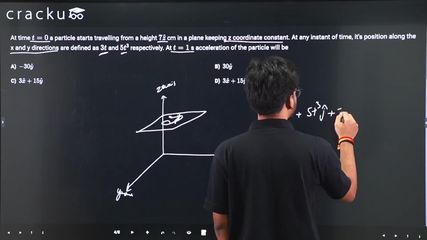
At time $$t = 0$$ a particle starts travelling from a height $$7\hat{z}$$ cm in a plane keeping z coordinate constant. At any instant of time, it's position along the x and y directions are defined as $$3t$$ and $$5t^3$$ respectively. At $$t = 1$$ s acceleration of the particle will be
We are given that at time $$t = 0$$, a particle starts travelling from a height $$7\hat{z}$$ cm in a plane, keeping the z-coordinate constant. The position coordinates along x and y at any instant are given as $$x = 3t$$ and $$y = 5t^3$$ respectively.
To find the acceleration, we need to differentiate the position twice with respect to time. The velocity components are obtained by the first derivative: $$v_x = \frac{dx}{dt} = 3$$ and $$v_y = \frac{dy}{dt} = 15t^2$$. Since z is constant, $$v_z = 0$$.
Now, the acceleration components are obtained by differentiating velocity: $$a_x = \frac{dv_x}{dt} = 0$$, $$a_y = \frac{dv_y}{dt} = 30t$$, and $$a_z = 0$$ (since $$v_z = 0$$).
At $$t = 1$$ s, the acceleration vector becomes $$\vec{a} = 0\hat{x} + 30(1)\hat{y} + 0\hat{z} = 30\hat{y}$$.
Note that even though the particle has a constant z-coordinate of 7 cm, this does not contribute to the acceleration since the z-position is not changing with time.
Hence, the correct answer is Option B.
Was this solution helpful?
Click on the Email ☝️ to Watch the Video Solution
Create a FREE account and get:
_1.webp)

Educational materials for JEE preparation

Ask our AI anything

AI can make mistakes. Please verify important information.
AI can make mistakes. Please verify important information.
