
Join Our JEE Preparation Group
Prep with like-minded aspirants; Get access to free daily tests and study material.
Sign in
Please select an account to continue using cracku.in
↓ →
Join Our JEE Preparation Group
Prep with like-minded aspirants; Get access to free daily tests and study material.
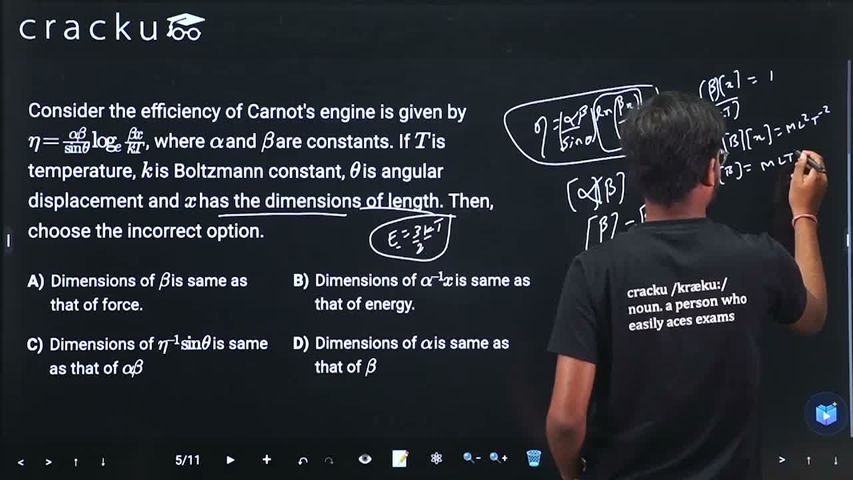
Consider the efficiency of Carnot's engine is given by $$\eta = \frac{\alpha\beta}{\sin\theta} \log_e\frac{\beta x}{kT}$$, where $$\alpha$$ and $$\beta$$ are constants. If $$T$$ is temperature, $$k$$ is Boltzmann constant, $$\theta$$ is angular displacement and $$x$$ has the dimensions of length. Then, choose the incorrect option.
We are given that the efficiency of a Carnot engine is expressed as $$\eta = \frac{\alpha\beta}{\sin\theta} \log_e\frac{\beta x}{kT}$$. Since efficiency $$\eta$$ is dimensionless and $$\sin\theta$$ is also dimensionless, the product $$\alpha\beta$$ must be dimensionless. Also, the argument of the logarithm $$\frac{\beta x}{kT}$$ must be dimensionless.
Since $$\alpha\beta$$ is dimensionless, $$\alpha$$ and $$\beta$$ must have reciprocal dimensions: $$[\alpha] = [\beta]^{-1}$$.
Now, from the condition that $$\frac{\beta x}{kT}$$ is dimensionless, we get $$[\beta] = \frac{[kT]}{[x]}$$. The Boltzmann constant $$k$$ has dimensions of energy per temperature, i.e., $$[k] = M L^2 T^{-2} K^{-1}$$. So $$[kT] = M L^2 T^{-2}$$ (energy). Since $$x$$ has dimensions of length $$[L]$$, we get $$[\beta] = \frac{M L^2 T^{-2}}{L} = M L T^{-2}$$, which is the dimension of force.
So the dimensions of $$\beta$$ are the same as that of force. This makes Option A correct.
Now, since $$[\alpha] = [\beta]^{-1} = M^{-1} L^{-1} T^{2}$$, let us check $$[\alpha^{-1} x]$$. We have $$[\alpha^{-1}] = M L T^{-2}$$ and $$[x] = L$$, so $$[\alpha^{-1} x] = M L^2 T^{-2}$$, which is the dimension of energy. This makes Option B correct.
For Option C, since $$\eta$$ is dimensionless and $$\sin\theta$$ is dimensionless, $$\eta^{-1}\sin\theta$$ is dimensionless. We already established that $$\alpha\beta$$ is dimensionless. So $$[\eta^{-1}\sin\theta] = [\alpha\beta]$$, both being dimensionless. This makes Option C correct.
For Option D, we found $$[\alpha] = M^{-1} L^{-1} T^{2}$$ and $$[\beta] = M L T^{-2}$$. These are clearly not the same dimensions (in fact they are reciprocals of each other). So Option D is incorrect.
Hence, the correct answer is Option D.
Was this solution helpful?
Click on the Email ☝️ to Watch the Video Solution
Create a FREE account and get:
_1.webp)

Educational materials for JEE preparation

Ask our AI anything

AI can make mistakes. Please verify important information.
AI can make mistakes. Please verify important information.
