
Join Our JEE Preparation Group
Prep with like-minded aspirants; Get access to free daily tests and study material.
Sign in
Please select an account to continue using cracku.in
↓ →
Join Our JEE Preparation Group
Prep with like-minded aspirants; Get access to free daily tests and study material.
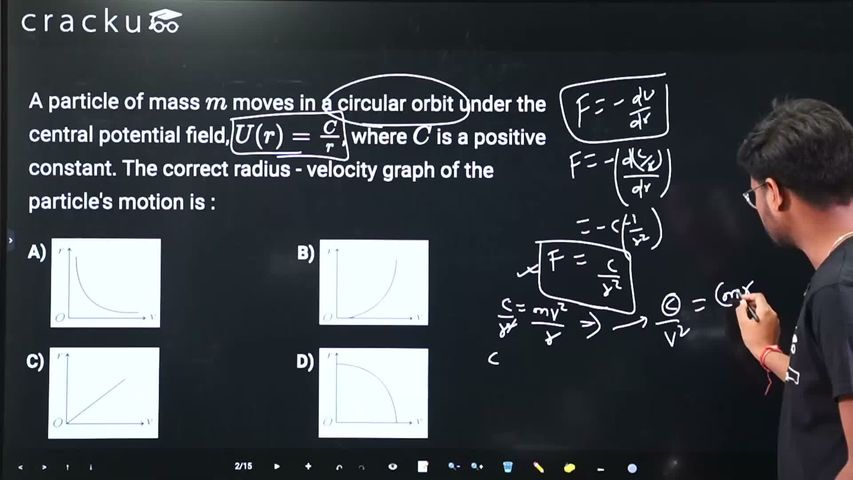
A particle of mass $$m$$ moves in a circular orbit under the central potential field, $$U(r) = \frac{C}{r}$$, where $$C$$ is a positive constant. The correct radius - velocity graph of the particle's motion is :
We need to determine the correct relationship between the radius $$r$$ and the orbit velocity $$v$$ of a particle moving in a stable circular orbit under a given central potential field.
From the problem, the central potential field is given by:
$$U(r) = \frac{C}{r} = C \cdot r^{-1}$$
Where $$C$$ is a positive constant.
The conservative central force $$\vec{F}$$ acting on the particle is related to the gradient of this potential energy by $$F = -\frac{dU}{dr}$$:
$$F = -\frac{d}{dr}\left(C \cdot r^{-1}\right) = -C \cdot (-1 \cdot r^{-2}) = \frac{C}{r^2}$$
This tells us that the particle experiences an attractive central force directed towards the origin whose magnitude is inversely proportional to the square of the radius.
For a particle of mass $$m$$ maintaining a stable circular orbit of radius $$r$$ with a constant tangential velocity $$v$$, this conservative central force provides the necessary centripetal force:
$$F_{\text{centripetal}} = \frac{m v^2}{r}$$
Equating the two forces gives:
$$\frac{C}{r^2} = \frac{m v^2}{r}$$
Simplify the equation by multiplying both sides by $$r$$:
$$\frac{C}{r} = m v^2$$
Isolate the radius $$r$$:
$$r = \frac{C}{m v^2}$$
Since both $$C$$ and $$m$$ are positive constants, we can express this relationship as a proportionality:
$$r \propto \frac{1}{v^2}$$
Let's analyze how the radius behaves as a function of velocity based on $$r = \frac{\text{constant}}{v^2}$$:
This inverse-square relationship yields a decreasing, non-linear curve that stays within the first quadrant, asymptotically approaching both the vertical $$r$$-axis and horizontal $$v$$-axis. This behavior matches the curve shown in the first graph option.
The correct radius-velocity graph of the particle's motion is represented by Option A.
Was this solution helpful?
Click on the Email ☝️ to Watch the Video Solution
Create a FREE account and get:
_1.webp)

Educational materials for JEE preparation

Ask our AI anything

AI can make mistakes. Please verify important information.
AI can make mistakes. Please verify important information.
