
Join Our JEE Preparation Group
Prep with like-minded aspirants; Get access to free daily tests and study material.
Sign in
Please select an account to continue using cracku.in
↓ →
Join Our JEE Preparation Group
Prep with like-minded aspirants; Get access to free daily tests and study material.
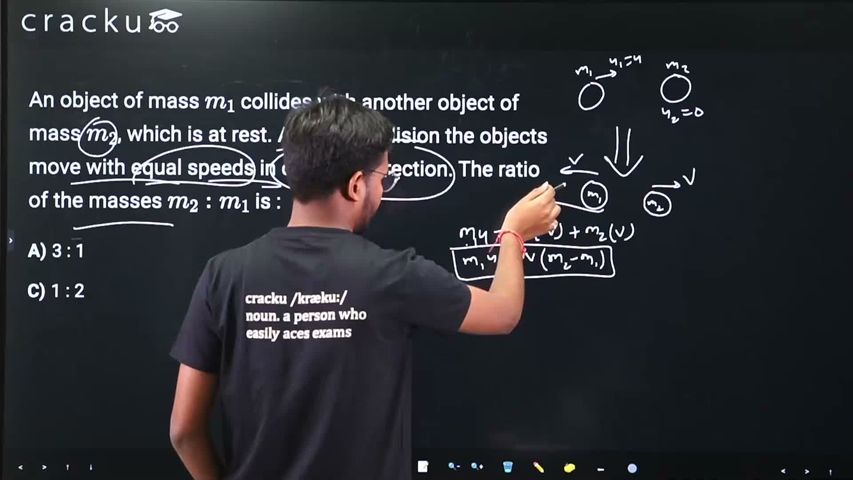
An object of mass $$m_1$$ collides with another object of mass $$m_2$$, which is at rest. After the collision the objects move with equal speeds in opposite direction. The ratio of the masses $$m_2 : m_1$$ is :
Let the initial velocity of $$m_1$$ be $$u$$ and $$m_2$$ is at rest. After collision, both move with equal speeds $$v$$ in opposite directions. So $$m_1$$ moves with speed $$v$$ in the negative direction and $$m_2$$ moves with speed $$v$$ in the positive direction.
Applying conservation of momentum: $$m_1 u = m_2 v - m_1 v$$, which gives $$m_1 u = v(m_2 - m_1)$$.
For the collision to be physically valid, we also use the coefficient of restitution. For elastic collision, $$e = 1$$: $$e = \frac{v - (-v)}{u - 0} = \frac{2v}{u} = 1$$, giving $$u = 2v$$.
Substituting into the momentum equation: $$m_1(2v) = v(m_2 - m_1)$$, so $$2m_1 = m_2 - m_1$$, which gives $$m_2 = 3m_1$$.
Therefore $$m_2 : m_1 = 3 : 1$$.
Was this solution helpful?
Click on the Email ☝️ to Watch the Video Solution
Create a FREE account and get:
_1.webp)

Educational materials for JEE preparation

Ask our AI anything

AI can make mistakes. Please verify important information.
AI can make mistakes. Please verify important information.
