
Join Our JEE Preparation Group
Prep with like-minded aspirants; Get access to free daily tests and study material.
Sign in
Please select an account to continue using cracku.in
↓ →
Join Our JEE Preparation Group
Prep with like-minded aspirants; Get access to free daily tests and study material.
A particle is released on a vertical smooth semicircular track from point X so that, OX makes an angle $$\theta$$ from the vertical (see the figure). The normal reaction of the track on the particle vanishes at point Y, where OY makes an angle $$\phi$$ with the horizontal. Then:
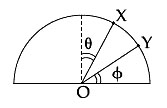
Let the potential energy be zero at the center $$O$$. The initial height of the particle at point $$X$$ relative to $$O$$ is $$h_X = R \cos \theta$$
At point $$Y$$, where $$OY$$ makes an angle $$\phi$$ with the horizontal, the height relative to $$O$$ is $$h_Y = R \sin \phi$$
By the Law of Conservation of Energy between points $$X$$ and $$Y$$:
$$mgR \cos \theta = mgR \sin \phi + \frac{1}{2}mv^2$$
$$v^2 = 2gR(\cos \theta - \sin \phi) \quad \dots (1)$$
At point $$Y$$, the forces acting on the particle along the radial direction are the normal reaction $$N$$ and the radial component of weight $$mg \sin \phi$$. The centripetal force equation is: $$mg \sin \phi - N = \frac{mv^2}{R}$$
The normal reaction vanishes at point $$Y$$ ($$N = 0$$). Therefore, $$mg \sin \phi = \frac{mv^2}{R}$$
$$v^2 = gR \sin \phi \quad \dots (2)$$
Equating $$(1)$$ and $$(2)$$: $$gR \sin \phi = 2gR(\cos \theta - \sin \phi)$$
$$\sin \phi = 2 \cos \theta - 2 \sin \phi$$
$$3 \sin \phi = 2 \cos \theta$$
$$\sin \phi = \frac{2}{3} \cos \theta$$
Was this solution helpful?
Create a FREE account and get:
_1.webp)

Educational materials for JEE preparation

Ask our AI anything

AI can make mistakes. Please verify important information.
AI can make mistakes. Please verify important information.
