
Join Our JEE Preparation Group
Prep with like-minded aspirants; Get access to free daily tests and study material.
Sign in
Please select an account to continue using cracku.in
↓ →
Join Our JEE Preparation Group
Prep with like-minded aspirants; Get access to free daily tests and study material.
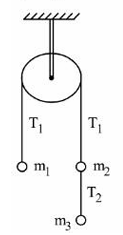
Three masses $$m_1 = 4$$ kg, $$m_2 = 4$$ kg and $$m_3 = 6$$ kg are suspended from a fixed smooth frictionless pully as shown in the figure below. The value of $$T_1/T_2$$ is _______. (take $$g = 10$$ m/s$$^2$$)
Solution :
Let acceleration of masses $$m_2$$ and $$m_3$$ downward be $$a$$.
Then mass $$m_1$$ moves upward with same acceleration $$a$$.
Given :
$$m_1 = 4\text{ kg}$$
$$m_2 = 4\text{ kg}$$
$$m_3 = 6\text{ kg}$$
For mass $$m_1$$ :
$$T_1 - m_1g = m_1a$$
$$T_1 - 40 = 4a$$
$$T_1 = 40 + 4a \quad ...(1)$$
For mass $$m_2$$ :
$$m_2g + T_2 - T_1 = m_2a$$
$$40 + T_2 - T_1 = 4a \quad ...(2)$$
For mass $$m_3$$ :
$$m_3g - T_2 = m_3a$$
$$60 - T_2 = 6a$$
$$T_2 = 60 - 6a \quad ...(3)$$
Substituting (1) and (3) into (2) :
$$40 + (60-6a) - (40+4a) = 4a$$
$$60 - 10a = 4a$$
$$14a = 60$$
$$a = \frac{30}{7}\text{ m s}^{-2}$$
Now,
$$T_1 = 40 + 4\left(\frac{30}{7}\right)$$
$$= \frac{400}{7}\text{ N}$$
and,
$$T_2 = 60 - 6\left(\frac{30}{7}\right)$$
$$= \frac{240}{7}\text{ N}$$
Therefore,
$$\frac{T_1}{T_2} = \frac{400/7}{240/7}$$
$$= \frac{5}{3}$$
Final Answer :
$$\frac{5}{3}$$
Was this solution helpful?
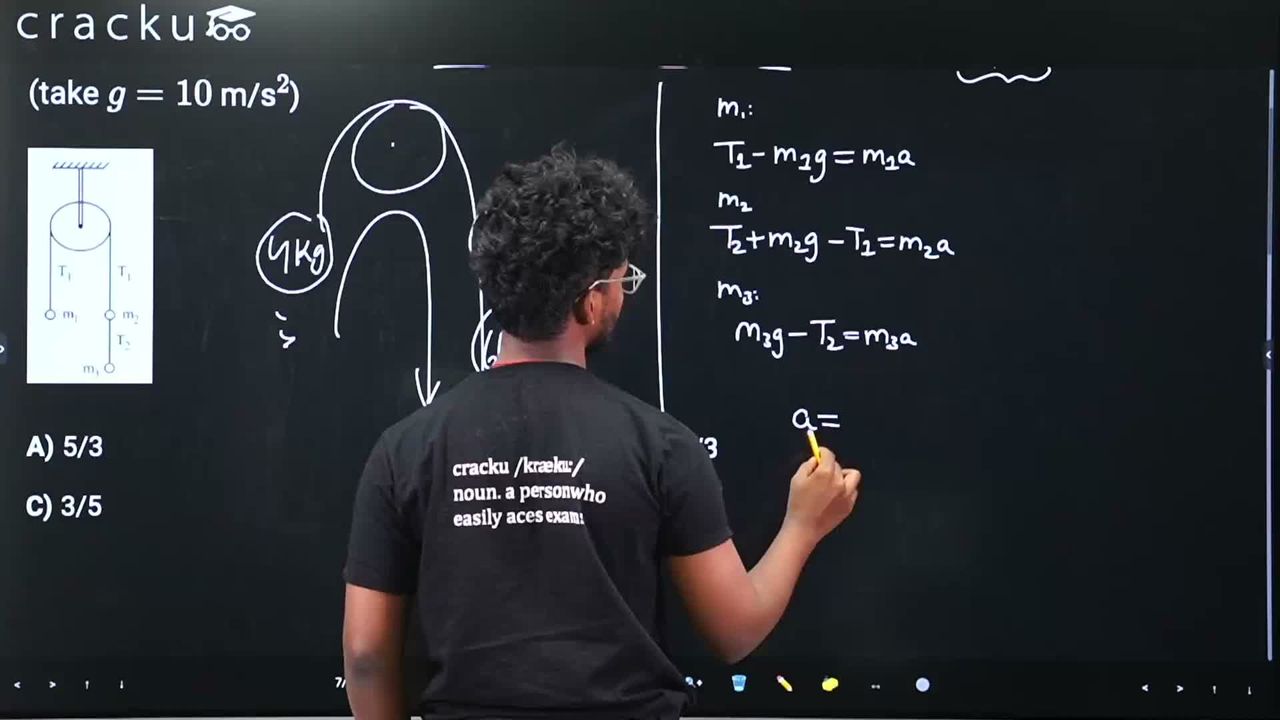
Click on the Email ☝️ to Watch the Video Solution
Create a FREE account and get:
_1.webp)

Educational materials for JEE preparation

Ask our AI anything

AI can make mistakes. Please verify important information.
AI can make mistakes. Please verify important information.


