
Join Our JEE Preparation Group
Prep with like-minded aspirants; Get access to free daily tests and study material.
Sign in
Please select an account to continue using cracku.in
↓ →
Join Our JEE Preparation Group
Prep with like-minded aspirants; Get access to free daily tests and study material.
A wedge Y with mass of 10 kg and all frictionless surfaces and the inclined surface making 37° with horizontal. A block X with mass 2 kg is placed at the highest point of the wedge as shown in figure is at rest. At $$t = 0$$ wedge (Y) is pulled toward right with constant force ($$f$$) of 24 N. Taking the block X at rest at $$t = 0$$, the time taken by it to slide down 8.8 m on the slope, while Y is on the move, is _______ s. (take $$\tan(37°) = 3/4$$ and $$g = 10$$ m/s$$^2$$)
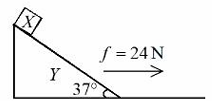
Let’s solve step by step.
step 1: acceleration of wedge
total mass = 10 + 2 = 12 kg
external force = 24 N
$$a_{wedge}=\frac{24}{12}=2m/s^2$$
step 2: go to wedge frame
pseudo force on block (mass 2 kg):
F_p=ma=2×2=4 N(towards left)
step 3: resolve along incline
incline angle = 37°
components:
gravity down the plane:
$$mg\sin37^{\circ\ }=2\times10\times\frac{3}{5}=12N$$
pseudo force component up the plane:
$$4\cos37^{\circ\ }=4\times\frac{4}{5}=3.2N$$
net force down the plane:
12−3.2=8.8 N
step 4: acceleration of block along plane
$$a=\frac{8.8}{2}=4.4m/s^2$$
step 5: motion along incline
distance = 8.8 m
initial velocity = 0
$$s=\frac{1}{2}at^2$$
$$8.8=\frac{1}{2}\times4.4\times t^2=2.2t^2$$
$$2t=4⇒t=2s$$
Was this solution helpful?
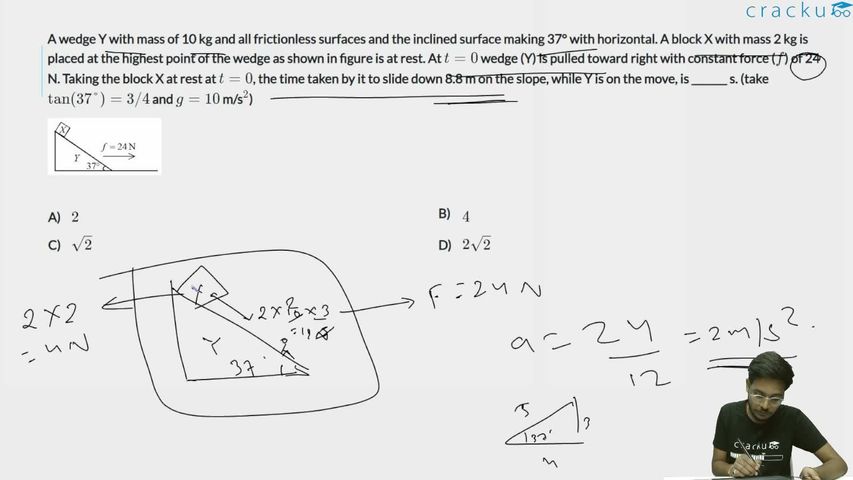
Click on the Email ☝️ to Watch the Video Solution
Create a FREE account and get:
_1.webp)

Educational materials for JEE preparation

Ask our AI anything

AI can make mistakes. Please verify important information.
AI can make mistakes. Please verify important information.


