
Join Our JEE Preparation Group
Prep with like-minded aspirants; Get access to free daily tests and study material.
Sign in
Please select an account to continue using cracku.in
↓ →
Join Our JEE Preparation Group
Prep with like-minded aspirants; Get access to free daily tests and study material.
A slanted object AB is placed on one side of convex lens as shown in the diagram. The image is formed on the opposite side. Angle made by the image with principal axis is:
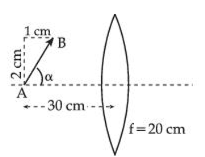
$$\tan\alpha = \frac{\text{Vertical Height}}{\text{Horizontal Length}} = \frac{dh}{du} = \frac{2\text{ cm}}{1\text{ cm}} = 2$$
$$\frac{1}{v} - \frac{1}{u} = \frac{1}{f}$$
$$\frac{1}{v_A} - \frac{1}{-30} = \frac{1}{20}$$
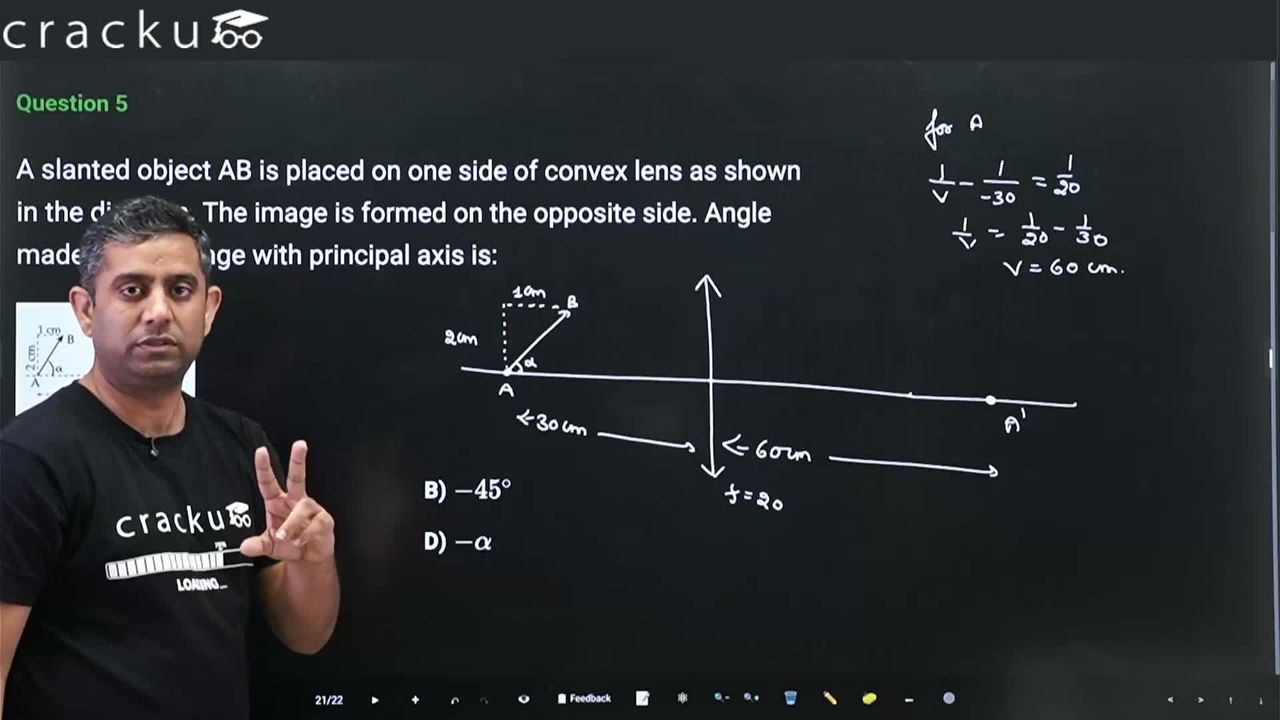
$$\frac{1}{v_A} = \frac{1}{20} - \frac{1}{30} = \frac{3 - 2}{60} = \frac{1}{60} \implies v_A = +60\text{ cm}$$
$$m_T = \frac{v_A}{u_A} = \frac{60}{-30} = -2$$
$$dh' = m_T \cdot dh = (-2) \times 2\text{ cm} = -4\text{ cm}$$ (Vertical dimension of image)
$$dv = m_L \cdot du = -m_T^2 \cdot du$$
$$dv = -(-2)^2 \times 1\text{ cm} = -4\text{ cm}$$ (Horizontal dimension of image)
$$\tan\theta = \frac{\text{Vertical dimension of image}}{\text{Horizontal dimension of image}} = \frac{dh'}{dv}$$
$$\tan\theta = \frac{-4\text{ cm}}{4\text{ cm}} = -1$$
$$\theta = \tan^{-1}(-1) = -45^\circ$$
Was this solution helpful?
Click on the Email ☝️ to Watch the Video Solution
Create a FREE account and get:
_1.webp)

Educational materials for JEE preparation

Ask our AI anything

AI can make mistakes. Please verify important information.
AI can make mistakes. Please verify important information.


