
Join Our JEE Preparation Group
Prep with like-minded aspirants; Get access to free daily tests and study material.
Sign in
Please select an account to continue using cracku.in
↓ →
Join Our JEE Preparation Group
Prep with like-minded aspirants; Get access to free daily tests and study material.
A cord of negligible mass is wound around the rim of a wheel supported by spokes with negligible mass. The mass of wheel is 10 kg and radius is 10 cm and it can freely rotate without any friction. Initially the wheel is at rest. If a steady pull of 20 N is applied on the cord, the angular velocity of the wheel, after the cord is unwound by 1 m, would be:
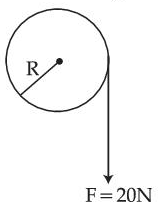
Since the wheel has negligible mass spokes, its mass is concentrated at the rim (treating it as a hoop/thin ring):
$$I = MR^2$$
$$I = 10 \text{ kg} \times (0.1 \text{ m})^2 = 0.1 \text{ kg m}^2$$
The work done by the pull (F) over the unwound distance (s) equals the change in rotational kinetic energy:
$$\text{Work} = \Delta KE_{rot}$$
$$F \cdot s = \frac{1}{2} I \omega^2$$
$$20 \times 1 = \frac{1}{2} \times 0.1 \times \omega^2$$
$$\omega = 20 \text{ rad/s}$$
Was this solution helpful?
Click on the Email ☝️ to Watch the Video Solution
Create a FREE account and get:
_1.webp)

Educational materials for JEE preparation

Ask our AI anything

AI can make mistakes. Please verify important information.
AI can make mistakes. Please verify important information.


